
Amul’s Latest Janmashtami OOH Advertisement Is Peak Experiential Marketing | Vigyapan Mart
Experiential OOH advertising turns the ad medium itself into part of the idea, instead of just displaying a message on it. Rather than printing a festival symbol on a billboard, brands physically recreate the moment - like Amul's Janmashtami campaign, which built a real human pyramid climbing toward a Dahi Handi matki on the billboard structure itself
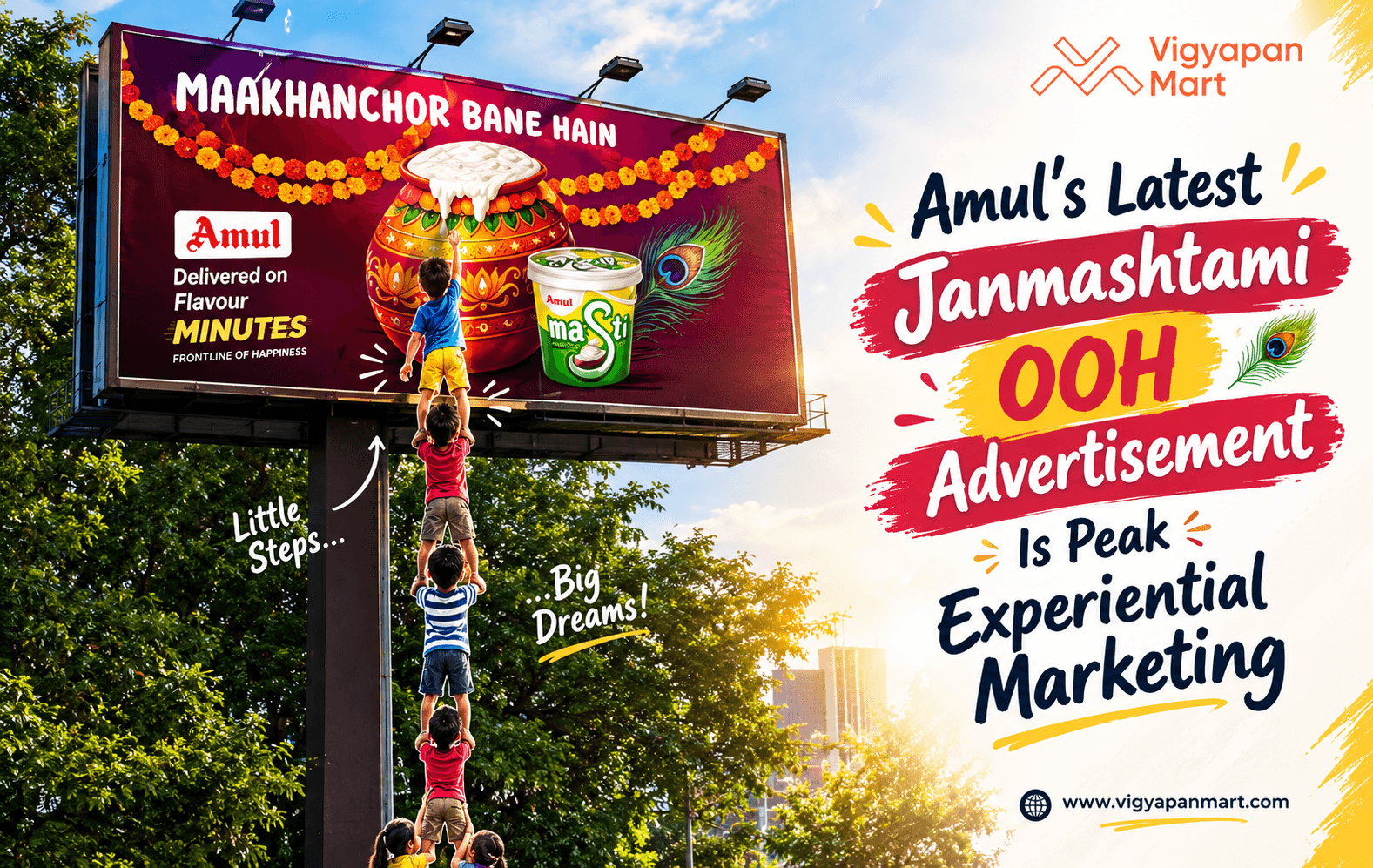
We have all seen billboard ads, and they do one thing – show the advertisement. But Amul’s latest Janmashtami campaign gives it a much more interesting job. For Janmashtami 2026, Amul Masti and Flipkart Minutes created an outdoor advertisement around the familiar Dahi Handi tradition.
Instead of simply putting up a poster, they have created a Human Pyramid on a billboard. The physical cutout climbs up the Matki placed on the billboard.
The headline reads:
“Maakhanchor Bane Mastikhor.”
Amul Didn't Put Dahi Handi on a Billboard. It Turned the Billboard Into Dahi Handi:
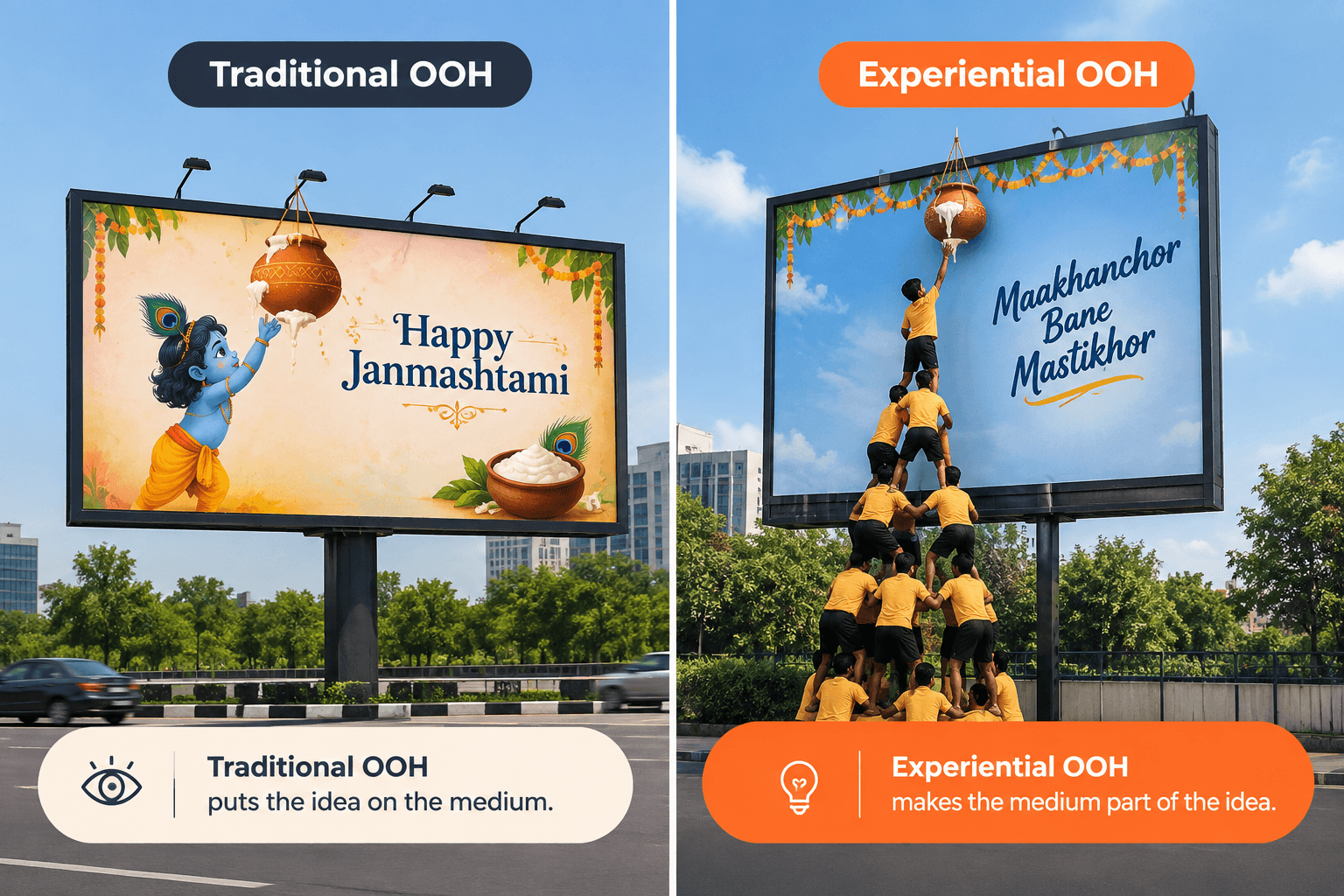
This is the biggest idea behind the campaign. A conventional festive billboard might show Krishna, a matki, a human pyramid and a product. Amul changed that old-school idea. The human pyramid has come out of the billboard artwork this time. The top kid appears to be reaching towards the matki on the billboard.
The difference here is this:
- Traditional OOH ads put the idea on the medium.
- Experiential OOH ads make the medium part of the idea.
The billboard ad is not showing Dahi Handi; it is physically recreating it.
The Smartest Part Was Choosing a Behaviour, Not Just a Symbol:
Janmashtami offers advertisers plenty of visual symbols. There is Krishna, the flute, the peacock feather, the Matki, and Makhan. All of these can become billboard graphics, but Amul created the human pyramid. WHY?
Because it shows real-life action. People create that formation and climb on it. It has movement, destination, and a strong physical action. It feels like it's happening in the real world. That makes it a new budget-friendly experiential OOH advertisement.
Instead of just putting symbols on the billboard ad, Amul used the cultural celebration as their USP.
That is a much stronger creative approach.
“Maakhanchor Bane Mastikhor” Makes the Product Part of the Story:
The physical execution gets attention, whereas the copy is how the brand connects with viewers. Amul excelled in both of them.
“Maakhanchor” instantly brings Krishna and his tales of stealing butter. Then comes “Mastikhor”, naturally connecting with Amul Masti [The Product].
So the communication creates a simple chain:
Krishna → Makhan → Janmashtami → Masti → Amul Masti
The brand doesn’t force itself into the festival. The festival leads to the product naturally.
Then Amul Added a Modern Consumer Behaviour:
There is another clever layer. The campaign is not only about Amul Masti. It also features Flipkart Minutes, connecting the product with quick commerce.
Note that this is not a simple co-branding exercise.
The two brands solve different parts of the consumer journey.
1. Amul owns the cultural moment.
2. Flipkart Minutes owns the convenience.
The journey becomes:
Festival → craving → product → instant availability
You see the Matki of Amul Masti, associate it with Janmashtami, and the billboard advertising shows the deliverability through Flipkart Minutes.
This gives instant connection and consumption behaviour.
The Quick-Commerce Numbers Make This Partnership More Relevant:
The Quick Commerce partnership is valuable in 2026, and the numbers given below clearly show WHY.
In June 2026, Flipkart Minutes crossed 1,000 micro-fulfilment centres across 130+ cities and 8,000+ pincodes. ( Source )
By September 2026, the platform had reached nearly 1,200 micro-fulfilment centres across more than 150 cities. ( Source )
Notably, the Tier-2 consumer base has grown nearly 25 times year-on-year. More importantly, around 60% of customers return to shop on the platform.
This is not just adding a delivery logo on a festival billboard. It is about connecting mass Indian consumers to a retail format that is rapidly growing beyond the cities too.
Why Does the Billboard Create a “Stop-and-Look” Moment?
People see thousands of billboards every day. Most billboards follow the same visual logic.
Rectangle → image → headline → product → logo.
Amul breaks it.
They created a pyramid that appears to climb outside the normal advertising space.
That creates visual interruption.
People notice something unusual, engage with the ad, and understand the brand message.
This creates a simple attention sequence:
Notice → Curiosity → Recognition → Brand association
That is extremely valuable in OOH ads because people may only have a few seconds to process an advertisement. Amul shows that experiential advertising does not need a complicated explanation.
The physical structure does much of the communication.
It Also Gives the Billboard a Second Life Online:
This is another major advantage of experiential OOH.
A conventional billboard mainly reaches people who pass it. A visually unusual billboard ad can become something people photograph and share.
Physical OOH → Photo/Video → Social Media → Industry Conversation → Additional Reach
In other words:
The billboard becomes content.
That is one of the strongest benefits of experiential OOH ads.
The brand is not paying separately to create a social-media visual. The physical installation creates something people already want to record.
Physical OOH Has an Advantage Even as DOOH Grows:
Such creative ad campaigns become more interesting because India’s DOOH industry is growing rapidly.
According to estimations, India’s OOH advertising market may reach up to ₹5,961 crore by 2028, and the DOOH share of India’s advertising revenue would rise up to 39.5% by 2028.
Digital OOH brings obvious advantages:
- Dynamic content
- Motion
- Multiple creatives
- Flexible scheduling
- Programmatic buying
But physical OOH ads can change the physical environment. Digital OOH advertising can never create it.
That distinction becomes more valuable when consumers are increasingly surrounded by digital screens.
When every billboard advertisement can become a screen, making a billboard become an object can be a powerful creative advantage.
Amul Has the Scale to Focus on Memorability:
The campaign becomes more powerful because it represents the brand AMUL.
This is a legacy company, and the whole India consumes its products. The Amul brand had a revenue of ₹90,000 crore in FY2024-25 and has crossed ₹1 lakh crore in FY2025-26. The brand has grown by 11% in 1 year. ( Source )
GCMMF, which markets the Amul products, says that its portfolio has more than 1,200 product packs and represents the interests of around 36 lakh dairy farmers.
At that scale, Amul does not need every advertisement to explain what Amul is.
Its advertisements focus on something else: being remembered. The Makhanchor Bane Mastikhor experiential OOH ad does just that.
What Other Brands Can Learn From Amul?
There are several practical lessons here.
1. Don't just decorate the medium.
Ask whether the billboard, bus shelter, wall or airport ad installation can become part of the creative.
2. Look for behaviours, not just symbols.
A cultural action can create a much stronger experiential advertisement idea than simply using a festival icon.
3. Build physical disruption into the idea.
You do not always need a giant advertisement installation. Even a small physical extension can break the expected visual pattern.
4. Make the product earn its place.
Amul Masti is not randomly inserted into the Janmashtami story. “Mastikhor” makes the product part of the idea.
5. Use partnerships to complete the consumer journey.
Flipkart Minutes does not merely add another logo. It adds the purchase and convenience layer to the OOH ad.
6. Create something that can travel.
The best experiential OOH ad can work twice: first on the street and then on social media.
Conclusion:
The AMUL Janmashtami OOH ad breaks one major rule of traditional OOH Advertising. Advertisers often ask this:
- “Can people see my advertisement?”
The new Experiential OOH asks:
- “Can people experience my idea?”
Amul's Janmashtami campaign moves towards the second question.
Amul took a familiar cultural behaviour, built it into the physical advertising environment, and connected it to the product through wordplay and adds a modern commerce layer through Flipkart Minutes.
That is why the campaign works. It has 3 layers of advertising. It makes the billboard participate in Dahi Handi. This is how brands and advertisers should look for now. Not just visibility but action & message.
This may be the most valuable lesson for OOH Marketers today. A billboard with the most impressive artwork may not work. The next great billboard could be the one that doesn’t behave like a billboard.
Looking for a new-age OOH advertising expert for your next viral OOH ad? Connect with Vigyapan Mart today.
Subscribe to our newsletter
Get updates instantly! Join our community for the latest marketing insights.