
What Makes Metro Station Branding More Effective Than Traditional Outdoor Advertising?
Metro station branding is more effective than billboards when a brand needs repeated, high-dwell-time exposure among daily commuters. Billboards work better for broad, one-time awareness across roads and highways. For most campaigns, the strongest results come from combining both: billboards for reach, metro stations for recall and action.
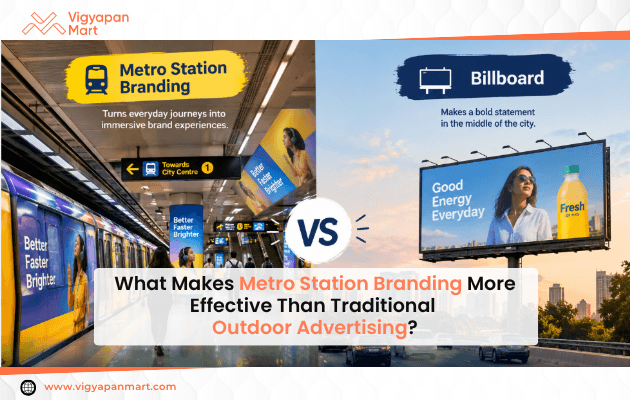
A metro station is more than just a transportation hub. It’s a place where thousands of people come every day to move to another place. It means you have 3 Metro-led environments where your ads can engage with commuters.
- The On-boarding station
- The Destinations
- Inside the Metro Trains
Plus, the commuters follow pre-designed routes and see the same physical spaces every day. That makes station branding different from a conventional roadside billboard.
A billboard engages with someone who may see it for only a few seconds. A metro station advertising works differently.
A commuter may see a brand while entering the station, again while walking towards the platform, once more while waiting for the train and perhaps again while exiting. The brand becomes part of the commuter's journey rather than a single roadside impression.
This difference is making metro station branding an increasingly important format within India's growing OOH advertising market.
Note: India’s transit OOH advertising holds 30% of the total market and will grow further due to the expansion of metro networks.
Metro Advertising
Metro advertising is a form of transit and outdoor advertising that displays brand messages across metro-related media spaces, including trains, stations and digital displays.
1. Metro Stations Offer Repeated Exposure:
One of the biggest advantages of metro advertising is Repetition.
A roadside billboard may reach thousands of people every day, but many of those viewers see it only once. But metro commuters often follow the same route repeatedly. Employees often travel five weeks a week and may see the ads multiple times a day and dozens of times in a month.
This creates an important opportunity for brands.
Metro Advertising enjoys repetition and so they are not under the pressure of being memorable.
This is especially useful for brands with high-cost products or services that require consideration before purchase.
2. Commuters Have More Time to Notice the Message:
A billboard fights against traffic, road signs, pedestrians and other advertisements. On the other hand, metro stations offer a very crucial advantage: DWELL TIME.
There are several activities that take time.
- Waiting for trains
- Walking through corridors
- Standing on the platforms
- Spending time around ticketing and interchange areas
This allows high dwell time and boosts brand recall.
But more importantly, this changes the way creatives are made. Metro advertising allows brands to use larger OOH ads, storytelling, QR codes, and sequential messaging.
The ads are not under pressure to share everything in under 1 second.
Billboard Advertising
Billboard advertising is a form of outdoor advertising that displays brand messages, images or offers on large-format advertising boards. Billboard advertising cost in India varies by city, location, board size, lighting (static or digital) and campaign duration, so brands should plan the budget based on their objective.3. The Environment Creates Context
Context can make an advertisement more meaningful.
Consider a fitness brand advertising near a station used heavily by office workers. Or a food delivery company advertising around a busy interchange during evening commuting hours.
The location itself provides information about the audience and their routine.
This is one reason station branding can go beyond simply putting a logo on a wall. Brands can design campaigns around the movement, behaviour and environment of commuters.
A campaign can cover pillars, walls, escalator panels, entry gates, platform screens and other station assets to create a connected brand experience.
4. Metro Advertising Can Dominate a Physical Space
Traditional outdoor advertising usually means owning one visual position.
Station branding can mean owning an entire environment.
For example, a brand can use multiple ad formats on a station to make it more immersive and effective:
- Platform panels
- Pillar branding
- Staircase and escalator branding
- Entry and exit areas
- Digital screens
- Concourse displays
- Train wraps
- Directional and experiential installations
This creates what advertisers often call station domination.
These ads don’t compete with dozens of roadside ads. Instead, the ads can become a part of the visual environment of their locations.
That association can be especially powerful when commuters pass through the station regularly.
5. Metro Networks Are Getting Bigger:
The metro network in India is constantly growing, and this is creating huge opportunities for brands.
Delhi Metro has more than 400 km of network and serves millions of passengers each day. In September 2026, due to the DTC bus Strike, the Delhi Metro recorded 82.45 lakh commuters in a single day.
The metro network is growing across the country, and with that, advertisers have more access to:
- Routes
- Stations
- Commuter Segments
It simply means that brands have more locations, more audience, and better routing.
6. Digital Screens Are Adding Flexibility
Metro station branding is no longer limited to printed posters. Digital OOH advertising is transforming it completely.
India’s digital OOH market may reach up to $6.41 billion by 2034. This growth is further supported by programmatic buying and digital signage in the transit ecosystem.
Digital screens can change advertisements, use digital smart tech to analyse the audience, and run the most relevant ads. This level of flexibility is not available with traditional static outdoor advertisements.
Transit Advertising
Transit advertising is a form of outdoor advertising that communicates brand messages through advertising media associated with public transportation systems.
7. Metro Branding Can Connect Offline and Online:
Metro train advertisements with QR codes, social media profiles, and website details can lead the viewers to online portals. This means your OOH ads aren't just raising awareness; they're pushing your audience to take action.
For example:
- A creative installation can encourage social sharing.
- A digital screen can promote a limited-time offer.
This creates a bridge between physical advertising and digital action.
For brands trying to measure campaign performance, this can make station advertising more trackable than a purely visibility-led campaign.
8. Metro Branding Is Not About Replacing Billboards:
Metro advertisements are not for replacing traditional outdoor advertising. Billboards are very useful when you want brand visibility. They can generate thousands of impressions in a single day.
But when it comes to more dwell time, engagement, and leading audiences to brand profiles, metro advertisements become your handy tools.
So, what to choose? A smart brand will use both formats strategically.
A billboard can create broad awareness.
Metro station branding can then create repeated, contextual and immersive exposure among commuters.
That combination can turn an OOH campaign from a single visual impression into a recurring brand experience.
Metro Station Branding vs Billboard: Key Differences
| Factor | Metro Station Branding | Billboard Advertising |
|---|---|---|
| Exposure type | Repeated, route-based | Traffic-based, often single-pass |
| Dwell time | High (platform, concourse, waiting areas) | Seconds |
| Creative format | Storytelling, QR codes, sequential messaging | Short, bold message |
| Audience targeting | Station and commuter-segment specific | Location and road specific |
| Digital connect | QR, URLs, DOOH screens | Limited |
| Best for | Recall, consideration, action | Mass awareness |
| Ideal use | Office-going, student, daily commuter audiences | Highway, city-wide, launch visibility |
How Can Vigyapan Mart Help With Metro Advertising?
Vigyapan Mart helps brands plan and execute metro advertising campaigns based on their audience, locations, objectives and budget. From station selection and media planning to train branding, digital formats and campaign execution, we provide end-to-end metro advertising solutions.
Conclusion:
India’s OOH industry is growing and moving beyond visibility. Now, with digital metro ads, a brand can target their audiences smartly, share the most relevant messages, and also lead audiences to digital profiles. Plus, digital metro ads can give more measurable results as well.
As metro networks are growing, more people are coming to stations, travelling through metro trains, and this is creating more opportunities for brands and advertisers.
Now the question is not ‘Where can people see our advertisement?’
It’s about ‘Do people experience our brand repeatedly?’
That is where metro station branding has a distinct advantage.
Looking for expert metro advertising in Delhi? Connect with Vigyapan Mart transit OOH experts today.
Frequently Asked Questions
Subscribe to our newsletter
Get updates instantly! Join our community for the latest marketing insights.