
Sivakasi: How 2 Cousin Brothers Built India's Fireworks Capital
Why is sivakasi called kutty japan, who started fireworks in sivakasi, ayya nadar shanmuga nadar, sivakasi match industry history, sivakasi printing industry, how much fireworks come from sivakasi
Published November 6, 2026
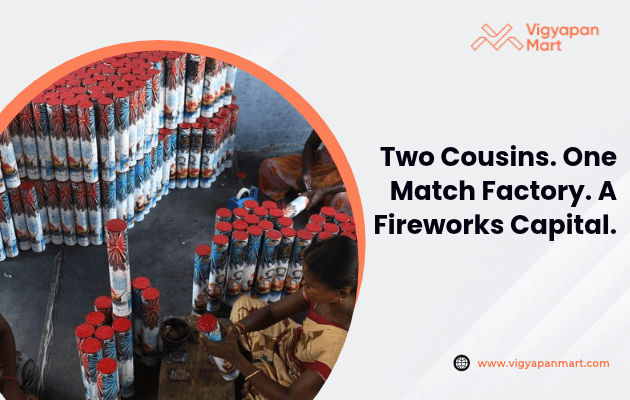
Sivakasi makes more than 85% of the fireworks India lights up on Diwali, according to a Business Standard report from October 2024. A century ago, it was a dry, drought-hit town in Tamil Nadu where farming alone could not support families.
Why is Sivakasi India's fireworks capital?
Quick Answer: Two cousins, P. Ayya Nadar and A. Shanmuga Nadar, learned match-making in Kolkata in 1922 and opened a factory in Sivakasi in 1923. They adapted it to local labour, matches led to fireworks, and fireworks pulled in printing and packaging. Diwali demand did the rest.
Sivakasi at a glance
| Fact | Detail |
|---|---|
| Location | Virudhunagar district, Tamil Nadu |
| Industry pioneers | P. Ayya Nadar and A. Shanmuga Nadar (cousins) |
| Learning trip to Kolkata | 1922, about eight months |
| First match factory | South-India Lucifer Match Industry (SILMI), 1923 |
| Share of India's fireworks output | More than 85% ( Business Standard, Oct 2024); some reports say around 70% |
| Workforce | About 4 lakh workers across 1,150 factories ( IANS, Oct 2024) |
| Diwali 2024 sales | About ₹6,000 crore, per the Tamil Nadu Fireworks Manufacturers Association ( IANS, Oct 2024) |
| Nickname | Kutty Japan ("Little Japan"), popularly attributed to Jawaharlal Nehru |
What was Sivakasi like before fireworks?
In the early 1920s, Sivakasi, in today's Virudhunagar district, was not a place anyone would have called prosperous. Low rainfall and water scarcity made farming a hard way to earn a living, and families needed another option.
Meanwhile, India's match industry was taking shape. Kolkata had become a match-making hub, with small factories using Japanese methods, while imported matches from Japan and Sweden filled Indian shops. For two cousins from Sivakasi, that looked less like competition and more like an opening.
How did two teenagers learn to make matches in Kolkata?
P. Ayya Nadar and A. Shanmuga Nadar travelled to Kolkata in 1922, still in their teens. They spent about eight months at a match unit there, introduced to the trade through a relative, Chinna Nadar.
The start was not glamorous. They were put in the packaging section, which kept them away from the real production work. But they did not give up. Accounts say they found a record book listing the chemicals and quantities used in match production, and picked up more from people connected to the trade, including Purna Chandra Ray.
They came home with something more valuable than a recipe: an understanding of how an industry worked, and how it might work somewhere else. Accounts differ on small details, but most place the trip in 1922.
What happened in 1923?
In 1923, the cousins set up the South-India Lucifer Match Industry (SILMI) in Sivakasi. They imported machinery from Germany, hoping a more organised process would help them compete.
It did not go to plan. Mechanised production needed good-quality wood, which was costly and hard to source consistently, and the machines pushed costs up. Copying an existing model was not enough. They needed one that fitted local conditions.
Why did they switch to cottage manufacturing?
They spotted Sivakasi's real advantage: people. Influenced by Mahatma Gandhi's call for Swadeshi and cottage industries, they moved to manual and semi-mechanised production. They reportedly sold the imported machinery and split the work into small tasks that trained local workers could handle.
That decision did two things:
1. It made production commercially viable in local conditions.
2. It created a model others could copy. Anyone could learn a step, train workers and open a unit.
That second point is what turned one factory into an industry.
Anil and Crow: two brands, one growing cluster
Around 1926, the cousins went separate ways in business. Ayya Nadar built the Anil (squirrel) brand, and Shanmuga Nadar built Crow.
The split did not slow Sivakasi down. People who had learned the craft started their own units, creating a network of small manufacturers, workers and suppliers. It was not one company growing huge. It was many independent entrepreneurs building around a shared skill.
How did matches lead to fireworks?
Match-making and fireworks share technical and material know-how, so moving from one to the other was a natural step. Manufacturers began with colour matches and Bengal Lights, which burn with coloured flames. Ayya Nadar and Shanmuga Nadar reportedly went back to Kolkata around 1930 to learn more about fireworks, and sparklers were among the early products made in Sivakasi.
Sources differ on the exact year the first fireworks unit opened, with some placing it in the 1930s and others in the early 1940s. What is clear is the shift in the business: from a household item to a festival-driven market with many product categories.
How did World War II and licensing shape the industry?
Before the war, India relied heavily on imported fireworks. Wartime trade disruption made imports and materials harder to get, which gave domestic makers room to grow.
In 1940, the Explosives Rules brought in licensing for making, possessing and selling explosives and fireworks, giving the industry a formal framework. By 1942, firms such as National Fireworks, Kaliswari Fireworks and Standard Fireworks were established in Sivakasi. Standard Fireworks traces its origins to 1942 under founder Yennarkay Rajaratnam.
Why Sivakasi? Six reasons it became India's fireworks capital
No single founder or decision explains it. Six factors worked together.
1. Climate. Sivakasi is hot, relatively dry and low on rainfall, conditions historically seen as favourable for making and storing matches and fireworks. Climate alone does not build an industry, though.
2. A local workforce. The cottage model split work into small steps, creating jobs without heavy machinery. Skills deepened over time.
3. A cluster of makers. As more entrepreneurs joined, suppliers and support services followed. It became a cluster, not a lone factory.
4. A wide product range. Sparklers, flowerpots, ground wheels, rockets, colourful fireworks and novelty items gave buyers choice at different price points.
5. Diwali demand. Makers built stock ahead of the festival and sold through distributors, wholesalers and retailers across India.
6. Supporting industries. Matches, printing, packaging, labels, chemicals and logistics each created demand for the others.
Take any one of these away and the story looks very different.
Why is Sivakasi called Kutty Japan?
"Kutty" means small in Tamil, so Kutty Japan means "Little Japan". The nickname is popularly credited to Jawaharlal Nehru, who was reportedly impressed by the town's energy, productivity and enterprise at a time when Japan stood for industrial discipline.
One honest caveat: published accounts repeat the Nehru attribution, but no dated speech, transcript or primary record of the occasion has been established in the sources we consulted. It is safest to say the name is "popularly attributed" to him.
Either way, the name stuck. It shows how a place can build an identity that travels far beyond its map.
How did printing become Sivakasi's third pillar?
Early on, match and fireworks makers had to rely on printers in other cities, including Bombay, for labels and packaging. As output grew, so did demand for printed material, and local entrepreneurs saw the gap.
K. S. A. Arunagiri Nadar founded National Lithographic Press, and S. Kaliappa Nadar contributed through Sivakasi Industrial Printing Works. Lithography and offset printing took hold, and Sivakasi built strength in product labels, matchbox printing, fireworks packaging, commercial printing, calendars and diaries, brochures, books and stationery.
Fireworks makers needed packaging. Match makers needed labels. Printers needed paper, ink, machines and skilled workers. Each industry's growth created work for the next.
Sivakasi today: how big is the industry?
More than a century after the first match factory, Sivakasi is still India's biggest fireworks cluster.
• Share of national output: more than 85% according to Business Standard (October 2024). Another report puts it nearer 70%, so treat it as an industry estimate.
• Scale: the Tamil Nadu Fireworks Manufacturers Association said Sivakasi factories sold about ₹6,000 crore of fireworks for Diwali 2024, with roughly 4 lakh workers across 1,150 factories (IANS, October 2024).
• Pressure: the same report said business owners saw production fall by at least 30% because of restrictions on joined crackers, after the Supreme Court reiterated its ban on barium nitrate.
These are industry estimates from different reporting periods and definitions.
What challenges does Sivakasi's fireworks industry face?
Every success story has a cost, and Sivakasi's deserves to be said plainly.
• Worker safety. Fireworks involve hazardous materials and processes. One report counted 17 accidents and 54 deaths in Sivakasi in 2024 alone. Compliance, training and responsible manufacturing remain critical.
• Environmental rules. Limits on air pollution, chemical composition and the sale of certain fireworks, including the barium nitrate ban, have changed what makers can produce.
• Seasonal demand. Much of the demand lands around Diwali, which creates inventory and cash-flow pressure.
• Raw material costs. Shifts in prices and availability affect margins.
• Competition and modernisation. Makers must keep improving quality, processes, compliance and positioning.
The industry has also faced serious, long-running concerns about unsafe working conditions and child labour. Any honest account of its growth has to acknowledge that. A successful industry should create not only jobs and revenue, but safe, responsible and sustainable workplaces.
Five business lessons from the Nadar cousins
1. Learn before you invest. The cousins went to Kolkata to understand an industry before building one. Market research and hands-on learning came first.
2. Fit the model to the place. The mechanised setup was too costly, so they rebuilt production around the workforce they actually had.
3. Grow into adjacent markets. Matches led to fireworks, and fireworks led to printing and packaging. Existing skills opened new doors.
4. Build an ecosystem, not just a company. Suppliers, printers, packers and distributors made the whole cluster stronger.
5. Build an identity people remember. "Sivakasi" became shorthand for fireworks. A product wins a sale, but a recognised identity wins recall.
What Sivakasi teaches about branding and marketing
A good product is only half the job. Sivakasi shows what happens when positioning, product range, distribution and supporting industries line up behind it.
For manufacturers today, that translates into:
• A clear brand identity and positioning
• A corporate website that explains what you make and who it is for
• Search engine optimisation, so buyers can find you
• Product catalogues and packaging design
• B2B lead generation and digital advertising
• Distributor and dealer acquisition campaigns
• Storytelling and social media
• Conversion tracking, so you know what is working
At Vigyapan Mart, we help manufacturers connect brand identity to measurable growth across digital, out-of-home and creative. Every business has a story. Not every business knows how to tell it. Talk to our team about yours.
Frequently Asked Questions
Subscribe to our newsletter
Get updates instantly! Join our community for the latest marketing insights.