
What Makes a Bus Advertising Campaign High-Performance in 2026?
Bus advertising in India is becoming smarter and more measurable in 2026. Learn how route selection, frequency, creative design, and digital integration make a bus advertising campaign truly high-performing.
Published September 8, 2026
Bus advertising has always been a powerful form of outdoor advertising. What makes bus advertising special is its ability to go into several high-potential areas such as: Busy markets, Residential areas, Office districts, Shopping streets, Highways.
It surely covers more area than a billboard ad and reaches those who may never notice a billboard while they are out.
But it's 2026, and you can’t expect people to respond to a brand logo pasted on buses.
People and companies both want OOH marketing to be more engaging, valuable, and to act as a portal to learn more. A good bus advertisement campaign today must have these 4 factors:
- Stronger recall
- Meaningful engagement
- Measurable actions
- Business results
Note: Transit advertising revenue grew 22% and held 30% of the Indian OOH advertising industry in 2025.
This is changing the way marketers should plan best bus advertising. But what truly matters for bus advertisements in 2026?
Bus Advertising
Bus advertising is a form of outdoor advertising where brand messages, images, or advertisements are displayed on buses and other bus-related spaces.
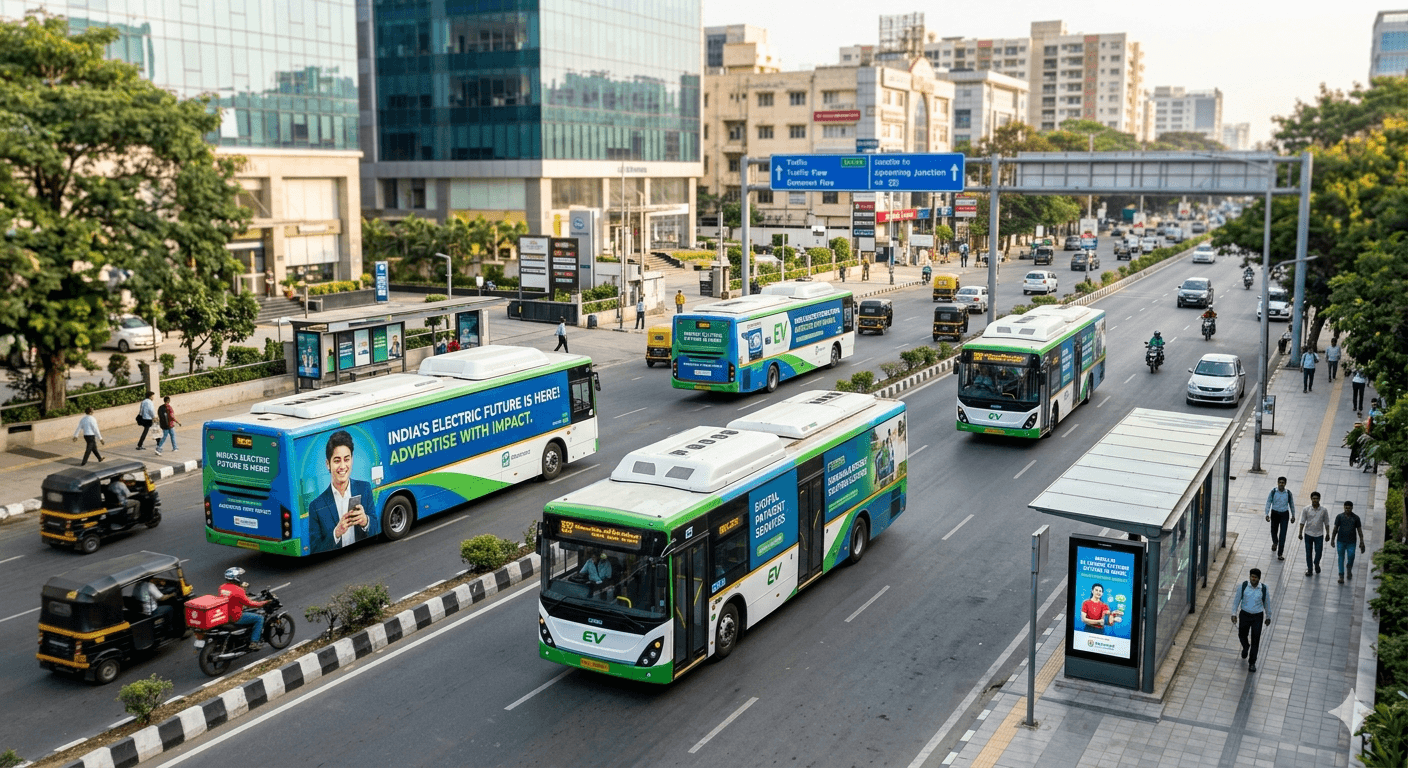
1. It Starts With the Right Audience, Not the Number of Buses:
The first mistake brands make is asking:
"How many buses can we brand?"
You must ask a better question.
“Which routes will show my ads to the right people?”
For example:
- A bus that travels through a high-income residential area is more suitable for premium brands.
- A route that passes through colleges is more suitable for a food delivery app or education brand.
- Bus ads that visit industrial areas are good for B2B products, financial services or workforce-focused brands.
We can say that route selection today is the key to right advertisement targeting. Your high-performance campaign maps should include one or more of the following:
- Target customer locations
- Residential clusters
- Offices and business districts
- Shopping areas
- Colleges and universities
- Transport hubs
- Competitor locations
- High-traffic corridors
Why? Your target should be maximum movement, but maximum relevant movement.
2. Reach Must Be Combined With Frequency
Reach tells you how many people potentially see your ad campaign. Frequency tells you how often they see it.
For bus advertising, frequency is extremely valuable. Since buses on the same route multiple times a day, it creates multiple exposure on the same route, multiple times.
People may see your ads in the morning, afternoon, and evening at different places.
Note: a bus advertising can generate roughly 30,000–70,000 OOH impressions per day [Depending on routes & traffic].
Source: (BMTC Bus Branding)
Repeated exposure gives you an important advantage. It turns the ad familiarity into recognition and brand recall.
This is why, when you plan bus advertisements, examine these:
Reach + Frequency + Target Audience Coverage.
3. Creative Must Work in Seconds
A bus is a moving object, and your audiences may be walking, driving, cycling or waiting at a signal. This means you can’t expect people to read a paragraph from the side of a bus.
Your ads need to communicate almost instantly. Here is what you need to make your ad engaging and instantly readable:
- One dominant visual
- One clear message
- Large typography
- Strong brand visibility
- Minimal copy
- A simple CTA
- High contrast
- Easy-to-understand imagery
Here is a genius trick:
Ask yourself: if someone sees your ads for 3 seconds, what would they remember?
Use simple messages like "Your Money. Your Future. Start Today."
OOH Advertising
OOH advertising, or out-of-home advertising, refers to advertisements displayed in public places outside homes, including billboards, transit media, metro stations, digital screens, and other outdoor formats.
4. The Bus Should Become Part of the Campaign, Not the Entire Campaign
The strongest bus ad campaigns in 2026 should connect your digital profiles to your OOH advertisements.
For example, you can place a QR code on a bus advertisement to lead your customers like this:
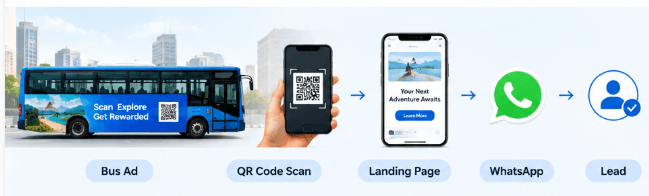
Bus → Brand Search → Website → Store Visit
This turns a traditional bus advertisement into part of a measurable customer journey.
This is an important shift because now the question is no longer:
"How many people saw my bus?"
It is:
"What happened after people saw my bus?"
5. Measurement Needs to Go Beyond Impressions
Impressions still matter. Reach still matters. Visibility still matters. But now they are only the beginning.
A high-performance ad campaign should track multiple layers of performance.
Exposure Metrics
- Estimated impressions
- Unique reach
- Frequency
- Route coverage
- Campaign duration
Engagement Metrics
- QR scans
- Website visits
- Social searches
- Landing-page visits
- WhatsApp enquiries
- Coupon redemptions
Business Metrics
- Leads generated
- Store visits
- Sales enquiries
- App downloads
- Online conversions
- Branded search growth
This creates a much stronger campaign report.
Always measure your bus advertisement efficiency with this approach:
- Reached X target consumers
- Generated Y QR scans
- Produced Z incremental enquiries.
That is a much more powerful and result-focused approach to your bus ads.
Auto Advertising
Auto advertising is a form of transit advertising where advertisements are displayed on or inside auto-rickshaws.
6. Location and Timing Should Work Together
A bus advertising in India campaign should not treat every hour and every route equally. Different times have different kinds & numbers of traffic. For an idea, morning hours see more employees, students, or daily commuters. Afternoon hours often see local traffic and small business people. Evening hours again see movement.
When you select the buses, think about their hourly locations. For example:
- A food brand should target office areas around lunch and evening hours.
- A jewellery brand advertisement should move through local business areas in the afternoon.
- Entertainment or retail brands should focus on evening hours when people like to shop or walk outside.
Note: brands should also consider weekends and weekdays timing and location.
Timing makes your advertisements more effective around the right people. The objective here is simple:
Put the message where the audience is most likely to need it.
7. Frequency Should Be Designed, Not Left to Chance
One of the biggest advantages of bus advertisements is repeated exposure. This means you should also design the frequency as best.
For example:
People may forget a bus ad campaign that has only run for five days but with a large fleet easily. On the other hand, people may remember bus advertisements that run on selected routes for several weeks.
Frequency improves recognition and leads to recall.
This is why the advertisement campaign duration matters. An experienced outdoor marketing agency like Vigyapan Mart always follows this strategy:
Broad reach + sustained presence + repeated exposure.
Results? Your brand becomes familiar.
Transit Advertising
Transit advertising is a form of outdoor advertising that places advertisements on or around transportation systems such as buses, autos, metros, trains, and other public transport vehicles.
8. Measurement Starts Before the Campaign
Don't add measurement after the buses are already on the road. Before launch, marketers should establish:
- Campaign objectives
- Target routes
- Baseline website traffic
- Baseline branded searches
- QR/URL tracking
- Lead tracking
- Store-visit benchmarks
- Geographic audience data
Then compare their advertisement performance during and after the campaign.
How Can Vigyapan Mart Help With Bus Advertising?
Vigyapan Mart is a bus advertising agency that helps brands plan and execute campaigns based on their target audience, routes, locations, campaign duration, and objectives. From route selection and creative planning to execution and campaign measurement, we provide end-to-end transit and OOH advertising service.
Conclusion:
In 2026, bus advertising is moving from visibility media to accountable media. Today, advertisers and brands don’t just look at buses. They connect everything:
Right Audience + Right Routes + Strong Creative + Frequency + Digital Integration + Measurement + Business Outcomes
The bus becomes the medium. It doesn’t lead the advertising campaigns.
Marketers today focus on developing the advertising journey where a user sees an ad, remembers the brand, and takes action. They're no longer just moving billboards; they have become a complete advertising funnel.
That is where the future of bus advertising lies. Want to launch your next bus advertising campaign with modern efficiency and planning? Connect with Vigyapan Mart experts today.
Frequently Asked Questions
Subscribe to our newsletter
Get updates instantly! Join our community for the latest marketing insights.