
Can bus advertising own a commuter's daily routine? the psychology of repeated exposure in transit media
How best bus advertising can own a commuter's daily routine - this is exactly what Vigyapan Mart delivers by making a campaign part of the commuter's unconscious ritual, appearing on the same route, at the same time, day after day.
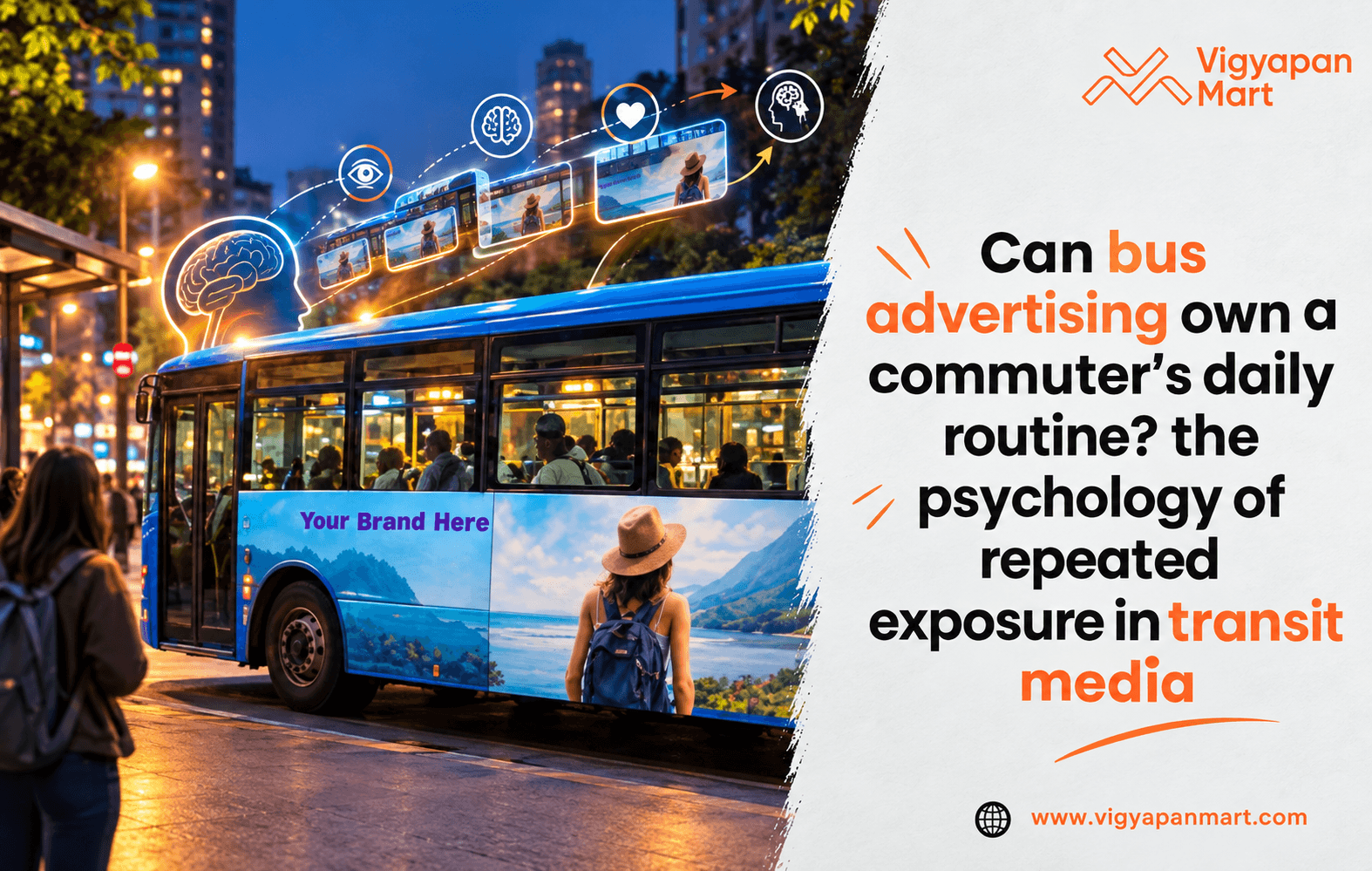
Bus advertisements run on open grounds, move with the commuters, and engage with people on the road.
It is super highly possible that your bus ads may not see the same person twice because they are on the move. But if the buses run on the same path, can you design the bus ads in a way that may engage with the commuters every day, multiple times?
For example-
An employee leaves home at 9:00 AM and sees your bus ad. At 6:30 PM, he takes a bus and returns. Now, can you design a bus ad that can engage with the commuter everyday multiple times? This one single thing can make your brand logo, colours, messages, and products more familiar in his mind.
This is where bus advertising becomes more than a moving billboard. It can become part of a commuter’s daily environment.
Bus advertising is an outdoor advertising format that places brand messages on the exterior or interior surfaces of buses. It can include full bus wraps, side panels, rear advertisements, interior displays and other transit media formats.
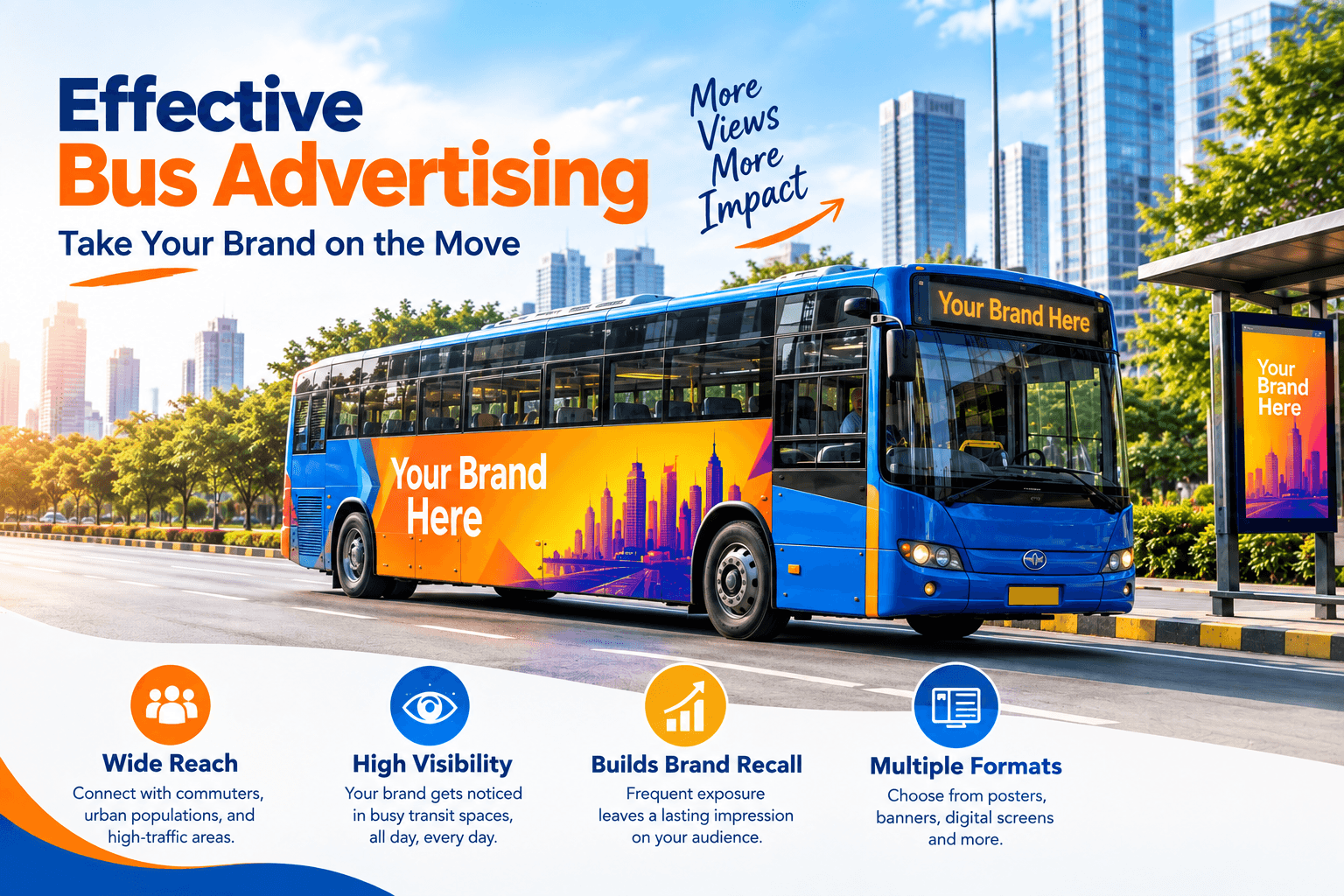
Repetition Is the Real Advantage of Bus Advertising:
- Traditional advertising often competes for attention. A social media user can scroll past an ad. A YouTube viewer can skip it. A newspaper reader can turn the page.
Bus advertising works differently. It depends on 3 major factors:
- Mobility
- Visibility
- Repeated Exposure
Your bus ad moves through the same roads at the same time. Plus, they can appear outside offices, residential areas, markets, schools, shopping areas, and transport hubs.
Brand Recall becomes natural, and it pushes a huge media advantage:
It reaches the same audience every day and engages with the new ones too.
The Psychology Behind Repeated Exposure:
According to the concept ‘Mere Exposure Effect’, people often develop great familiarity with anything that they see repeatedly.
Repeated exposure increases brand familiarity, repetition, and recall. However, the repetition generally follows an inverted-U pattern, which means it may not guarantee better results.
But the advertising industry gains benefits because the commuters may not consciously engage with the ad but gain brand recall due to multiple exposure.
Consider a commuter who sees the same bus every morning.
Day 1: “I have seen this brand.”
Day 7: “That logo looks familiar.”
Day 20: “I know this company.”
Day 30: “I have been seeing this brand everywhere.”
Bus advertisements slowly grow in commuters’ minds and become a part of the commuter’s visual environment.
E-Rickshaw Advertising
E-rickshaw advertising involves displaying promotional messages, brand visuals or product information on e-rickshaws. These mobile advertisements can operate across residential areas, markets, commercial streets and other high-movement locations.
A Bus Can Turn Frequency Into a Media Asset:
This is where bus advertising differs from a conventional billboard.
A billboard owns a location.
A branded bus owns a route.
That route may pass through multiple high-traffic points during the day. The same vehicle can therefore create exposure across several neighbourhoods and consumer environments.
According to a report, the transit advertising was about 30% of India's OOH market in 2025 (approx ₹20.2 billion), and it is expected to reach up to 33% by 2028.
However, one shift is clearly visible in this growth.
Advertisers are no longer looking for just the number of viewers. But they also look for the potential advertising frequency of their ads.
Familiarity Can Matter More Than a Single Big Impression:
Let’s take two advertising campaign examples:
Campaign A:
- Place a large advertisement on one major road.
- Thousands of people see it once.
- Create a powerful first impression.
Campaign B:
- Place branded buses on routes that engage with the same people every day.
- Build familiarity through repetition.
Both approaches play important respective roles. But for brands that need awareness over time, they require repeated exposure for brand recall.
Now, talking about the number of brand repetitions, the success of real-world bus ad campaigns depends heavily on:
- Route
- Audience
- Creative Quality
- Duration
- Media Placement
Here is the lesson:
You should plan the frequency as a strong pillar of your advertisement strategy, not as a by-product. But repetition doesn't mean success.
The creative still needs to work.
Bus advertising usually gives people only a few seconds to process a message. That makes simplicity critical.
A strong bus advertisement should communicate:
- One clear brand idea
- A recognisable logo
- High visual contrast
- Short and readable copy
- A memorable product or benefit
- A simple call to action
Research also shows that attention matters. Studies of the mere exposure effect suggest that repeated exposure does not affect every element of an advertisement equally. Attention can influence which parts of an advertisement actually benefit from repetition.
This is why a complicated bus creative can waste the advantage of frequency.
If commuters repeatedly see an advertisement but cannot understand it within seconds, repetition may simply reinforce visual noise.
Metro Advertising
Metro advertising is an OOH advertising format that uses metro trains, stations and commuter spaces to display brand messages. Common formats include train branding, platform panels, station branding, digital screens, pillars and escalator advertising.
How Can Vigyapan Mart Help With Bus Advertising?
Vigyapan Mart helps brands plan and execute bus advertising campaigns based on their target audience, routes, locations, campaign duration and marketing objectives. From route selection and creative planning to vehicle branding and campaign execution, Vigyapan Mart provides end-to-end transit advertising solutions.
Conclusion: The Goal Is to Become Part of the Routine:
The most interesting possibility in bus advertising is not that a commuter notices an advertisement once. It is that the brand becomes familiar because it keeps appearing in a familiar environment.
- The commuter already has a routine.
- The bus route is fixed.
- The roads are familiar.
- The morning journey repeats.
- The evening journey repeats.
A well-planned bus campaign can attach a brand to that existing routine. Over time, the consumer may not think, “I am looking at an advertisement.”
They may simply think, “I know this brand.” That is the real power of repeated exposure. For marketers, therefore, the question should not only be “How many people will see our bus advertisement?”
It should also be:
“How many times can the right people encounter our brand along the routes they already travel?”
Because in transit media, one exposure can create awareness. But repeated exposure can create familiarity, and familiarity is often where lasting brand memory begins. Searching for experts for bus OOH advertising in Delhi? Connect with Vigyapan Mart marketing professionals today.
Frequently Asked Questions
Subscribe to our newsletter
Get updates instantly! Join our community for the latest marketing insights.