
DOOH vs. Traditional OOH: The Shift Every Marketer Needs in 2026
DOOH vs Traditional OOH highlights the major shift in OOH advertising for 2026. While traditional billboards offer mass reach, DOOH advertising delivers real time updates smart targeting measurable ROI and stronger engagement for Indian brands in competitive urban markets.
Published April 11, 2026 · Updated April 13, 2026
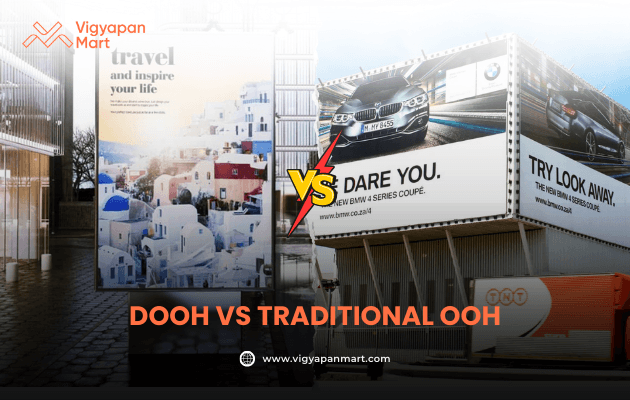
In today's busy world, OOH advertising remains a top choice for brands in India. But in 2026, a big change is coming for brands. Traditional OOH media such as fixed billboards and posters is giving away to DOOH. These are digital OOH ads with LED screens and smart tech. According to industry reports, global DOOH spending will grow fast, reaching over $20 billion soon. This is one of the reasons why OOH marketing in India is also expected to hit ₹5,000 crore. But why is this shift happening?
Traditional OOH lacks tracking and quick changes. On the other side, DOOH offers real-time ads that hit the right people at the right time. For marketers, ignoring this means missing out on better results in cities like Mumbai and Delhi. But if you need more depth into why you should choose DOOH over the static OOH ads, this blog will help you. In this blog, we will discuss a brief comparison between the two and show why DOOH is the future of OOH marketing in 2026.
What is Traditional OOH?
Traditional OOH advertising is the classic way to reach people outside the home. Think big billboards on highways, posters at bus stops, or ads inside trains. These are traditional OOH advertising methods that use printed materials that stay the same for weeks or months.
Why does it still matter? It's affordable and reaches lakhs of viewers every day. In India, brands like Amul and Hero MotoCorp have built fame with these simple, bold visuals. Everyone sees them while commuting. But there are challenges for such ads:
- They are fixed and can’t be changed very often.
- Damages are always a real threat under extreme conditions.
- Putting up special festival-centred ads while running another campaign may be difficult.
- Guesswork is the only method to track their success.
- Vandalism or fading ink adds costs.
In 2026, with smartphones everywhere, static OOH advertising feels outdated for smart marketers.
What is DOOH? The Digital Evolution
DOOH is the next level of OOH advertising. It uses digital screens in malls, airports, and metro stations. The best thing is that its content changes in seconds using software.
Its key features include:
- Geo-targeting that shows ads based on location.
- Real-time updates
For example, a coffee brand can push hot drink ads on rainy days. Platforms like LCD displays make OOH advertising interactive with QR codes. Notably, DOOH is booming in urban spots. Brands love it for quick campaigns during IPL or Diwali. WHY? Because it's flexible, weather-proof, and runs 24/7, making OOH advertising more powerful.
Head-to-Head: DOOH vs. Traditional OOH
Let's compare DOOH and traditional OOH advertising side by side:
| Content | Static prints | Live digital updates |
| Targeting | General crowds | Location, time, weather data |
| Measurement | Footfall guesses | Exact views and clicks |
| Cost | Low start, high waste | Higher but better returns |
| Flexibility | Fixed schedule | Instant changes, A/B tests |
Why the Shift Matters in 2026?
By 2026, OOH advertising will be mostly digital. The overall global trends show DOOH growing at 15-20% yearly. In India where the population is the highest in the world, DOOH fits perfectly for retail and auto brands. For example, Zomato uses DOOH on metro screens for local deals, and this helps them secure more orders through online integration. Static OOH can’t match this precision. Results? Better ROI with trackable metrics such as impressions and conversions. Sticking to old ways risks losing to competitors who embrace DOOH.
Challenges and How to Overcome Them
- Higher upfront costs for screens and tech setup.
Solution: Start small with a single-screen pilot; seek government subsidies or shared networks in India.
- Need for technical knowledge to manage digital platforms.
Solution: Train your team via free online courses (e.g., Google Digital Garage) or hire freelancers initially.
- Creating short, engaging content to prevent viewer overload.
Solution: Use tools like Canva or Adobe Spark for quick 5-10 second videos; test with A/B splits.
- Limited availability of DOOH screens in smaller cities.
Solution: Focus on urban hubs first, then partner with expanding networks like Moving Walls.
- Dependence on a stable internet and power supply.
Solution: Choose providers with backups; opt for solar-powered screens in outage-prone areas.
- Measuring true ROI amid mixed media channels.
Solution: Integrate QR codes and attribution tools like Google Analytics for end-to-end tracking.
Conclusion
The shift from traditional to DOOH is reshaping OOH advertising in 2026. DOOH brings smart and fast marketing with data-based results. Static OOH ads can never offer this. In 2026, DOOH will become essential in India’s growing market. So, what should you do next? Review all your current OOH ads now and see the improvement points. Next, partner with Vigyapan Mart DOOH experts to try a DOOH pilot, track every view, and scale up your OOH game.
Subscribe to our newsletter
Get updates instantly! Join our community for the latest marketing insights.