
Is the Future of Billboard Advertising About Fewer Sites With Better Audience Quality?
Billboard advertising in India is shifting from more sites to better audience quality. See how digital OOH & data are reshaping outdoor ads.
For years, billboard advertising followed a simple logic:
More locations = more visibility.
Brands bought multiple hoardings across a city to maximise reach. The larger the network, the stronger the campaign looked. But outdoor advertising in india is changing.
Today, marketers have access to better audience data, mobility insights, digital screens, programmatic buying and campaign measurement. This is changing one important question:
Do brands really need more billboard sites, or do they need better sites?
The answer is increasingly moving towards the second.
According to the reports, India's out of home advertising market may reach up to US$798 million by 2029 with a 7% CAGR.
But most importantly, digital OOH advertisements will hold nearly 45% of total OOH revenue by 2029, growing at a 16.5% CAGR.
This growth clearly shows that there is a more data driven future for outdoor advertising.
Billboard Advertising
Billboard advertising in india is a form of outdoor advertising that displays brand messages, images, or advertisements on large boards placed along roads, highways, commercial areas, and other high-visibility locations.
The Problem With Buying Too Many Sites:
For example, consider that a brand has acquired 100 spots for installing billboard advertisements. This sounds great and promising, but out of 100, 30 locations only get a handful of traffic. The other 20 locations are visible to the same people throughout the day. And most notably, several sites have poor visibility, short viewing time or little relevance to the brand’s target consumers.
This ensures one thing:
A higher number of sites is not equal to quality of exposure.
A billboard is valuable because it is visible to thousands of people. Poor visibility, low or same traffic means your billboard is just eating your money.
Some of the top choices for billboards are:
- busy business district
- airport
- metro corridor
- shopping zone
- high-income residential area
These areas deliver more value to brands than other weaker areas.
Audience Quality Is Becoming More Important:
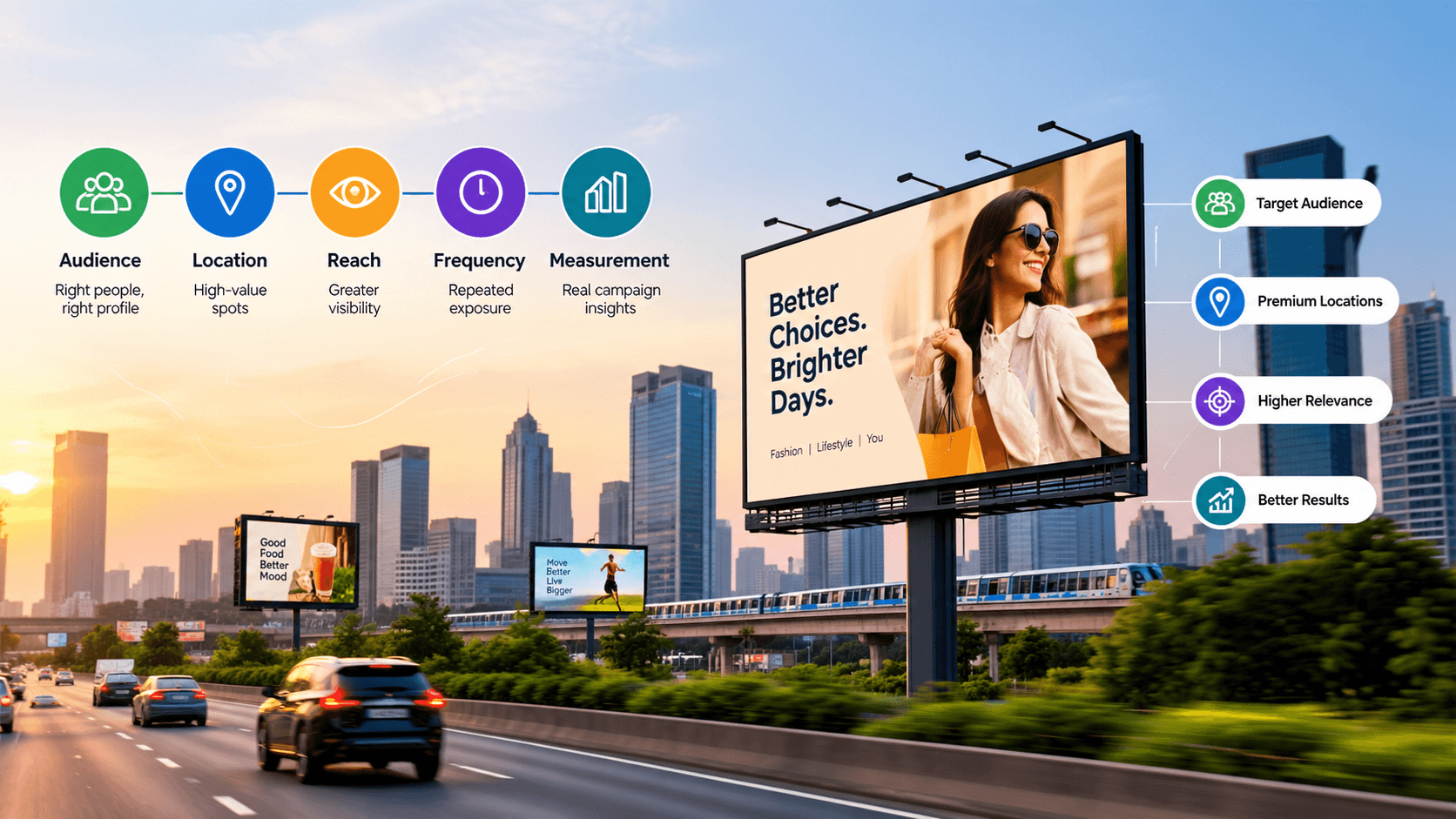
Modern OOH planning can look at much more than vehicle or pedestrian movement.
Brands can consider:
- Who travels through the location?
- When do they travel?
- How frequently do they pass the site?
- What is the average dwell time?
- Is the audience relevant to the product?
- What other commercial locations are nearby?
- Can the audience be reached repeatedly?
- Can the campaign be measured?
This changes the definition of reach. A million impressions are not automatically equal.
For example, a luxury automobile brand may prefer fewer premium sites near airports, business districts and affluent neighbourhoods. A quick-commerce brand may prioritise screens near dense residential areas and retail clusters.
The objective is not maximum exposure at any cost.
It is the maximum relevant exposure.
Digital Billboards Make This Shift Easier:
Digital OOH is accelerating this change because one screen can serve multiple campaigns and messages throughout the day.
According to the reports, the Indian Digital OOH advertising market may reach US$6.41 billion by 2034 with 11.39% CAGR.
Currently, billboards account for 42% of the market in 2025. This is only going to grow because of the flexibility they offer.
A brand can change creative based on:
Time → Audience → Location → Context → Event
A food brand could promote breakfast in the morning, a lunch offer around noon and an evening delivery message later in the day.
A retailer could promote products during peak shopping hours.
An automobile brand could change messaging around a major sporting event or local occasion.
The same physical asset can therefore become multiple advertising opportunities.
Auto Rickshaw Advertising
Auto rickshaw advertising is a form of transit advertising where brand messages, images, or promotional content are displayed on the exterior or interior of auto-rickshaws.
Programmatic Buying Could Make Site Selection Smarter:
Programmatic DOOH adds another layer.
Instead of manually selecting every billboard for a campaign, advertisers can increasingly use technology to select screens based on predefined audience, location and timing requirements.
This brings OOH closer to the logic of digital advertising. But there is an important difference. The goal should not be to make outdoor advertising behave exactly like online advertising.
OOH's strength is still its physical presence.
The opportunity is to combine that physical impact with better data. Research on India's OOH market shows that programmatic tools are enabling more granular audience targeting, while high-dwell environments such as airports and transit hubs are becoming strategically important because advertisers can deliver multiple messages during longer waiting periods.
Measurement Will Decide Which Sites Survive:
Better measurement could ultimately make poor-quality inventory harder to justify.
India's OOH industry has already been moving towards stronger audience measurement. PwC notes that the India Out of Home Advertising Association launched an audience measurement tool in 2024 using real-time GPS-based insights, with an ambition to cover 85% of India's OOH market by 2025.
This matters because advertisers can increasingly ask:
What did we actually buy?
Not just:
How many billboards did we buy?
The answer can involve reach, frequency, audience composition, location quality and campaign performance.
That creates pressure on media owners to improve the quality of their inventory.
Premium Locations May Become More Valuable:
There is already evidence of this shift. According to a report from EY, India’s OOH media grew 13% in 2025. Premium properties and locations are leading the growth, and digital OOH ads now account for 18% in 2025 from 7% in 2023.
The future of OOH advertisements may not be only about putting up a billboard but to trust its effectiveness.
It may be about owning the right moments in the consumer journey.
A few strategically selected locations can create repeated exposure among a highly relevant audience.
For example, a campaign could combine:
Airport + Business District + Premium Retail + Metro + Residential Catchment
Digital OOH Advertising
Digital OOH advertising is a form of outdoor advertising that uses digital screens to display advertisements in public places such as roads, malls, airports, metro stations, bus stops, and commercial areas.
Does This Mean Fewer Billboards Everywhere?
Not necessarily. Mass-reach campaigns will still need scale. FMCG, telecom, entertainment, political campaigns, large retail launches and national brands may require extensive networks to build awareness quickly.
But even large campaigns can become more intelligent.
Instead of treating every site equally, marketers can create different layers:
Tier 1: High-value flagship locations
Tier 2: High-frequency audience locations
Tier 3: Supporting reach locations
This creates a more efficient media mix.
The future, therefore, is not necessarily fewer billboards. There are fewer wasted impressions.
What Does This Means for Brands?
The next generation of billboard planning will likely focus on five questions:
- Who will see the advertisement?
- How often will they see it?
- Where does this audience spend time?
- How relevant is the location to the brand?
- Can the campaign's delivery be measured?
This changes the role of the OOH agency.
It is no longer enough to provide a list of available sites.
Agencies need to help brands understand why a location matters.
That means combining audience data, mobility patterns, location intelligence, creative strategy and campaign measurement.
How Can Vigyapan Mart Help With Billboard Advertising?
Vigyapan Mart helps brands plan and execute billboard and OOH advertising campaigns based on their target audience, locations, budget, and campaign objectives. From site selection and media planning to creative execution and campaign management, we provide end-to-end OOH advertising solutions.
Conclusion:
Billboard advertising is unlikely to disappear simply because digital advertising continues to grow.
In fact, India's OOH market continues to expand.
But the way brands evaluate billboards is changing.
The old question was: “How many sites can we get?”
The new question is: “How valuable is the audience behind each site?”
That is the bigger shift. Now the focus is on:
Visibility + Right Audiences + Exposure + Context + Measurements
The next phase of OOH advertising: winning campaigns may not be about the number of billboards but the relevance. Searching for experts to launch modern billboard advertisement campaigns for your business? Connect with Vigyapan Mart today.
Frequently Asked Questions
Subscribe to our newsletter
Get updates instantly! Join our community for the latest marketing insights.