
What Metro Advertising Formats Will Deliver the Highest Impact for Brands in 2026?
The best metro advertising format depends on your campaign goal. Full-train branding gives maximum visibility, station domination suits product launches, DOOH screens work for dynamic campaigns, platform panels build repeated awareness, and station + QR campaigns drive local conversions.
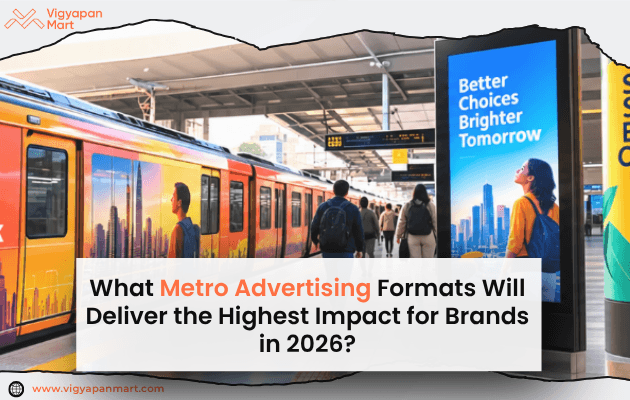
Metro advertising is growing, and the opportunities are growing with the Metro itself.
Metro advertisements are not just about putting up ads anymore. It’s 2026, and people are looking for new creative ways that brands can engage them with.
India had around 1,095 km of operational metro and RRTS network across 26 cities by 2025, compared with just 248 km across five cities in 2014. (Press Information Bureau)
At the same time, India's OOH industry is becoming more digital.
Note: According to research, India's digital OOH advertising revenue is projected to grow from 18% in 2025 to 25% by 2028. The report also says that assets like Metro and Transit hubs will be the highlight of this growth.
This ensures one thing: Metro OOH Ads will grow. Now the question is: what format should you choose?
Transit Advertising
Transit advertising is a form of outdoor advertising where brands put ads on buses, metros, trains, auto-rickshaws, and other public transport vehicles.
1. Full-Train Branding:
Few metro formats create as much visual impact as a fully branded train.
A full exterior wrap turns the train into a moving billboard. It gives a brand visibility both inside stations and along elevated or surface sections of the route.
This format works particularly well for:
- Product launches
- Automobile brands
- OTT and entertainment campaigns
- Fashion and lifestyle brands
- Large consumer brands
For examples:
- Exterior Wraps
- Interior Advertising
- Panels above seats, doors, and coach surfaces
The biggest advantage is repetition. A commuter may see the same branded train several times during a regular journey or across multiple days.
2. Complete Station Branding:
If full-train branding owns the vehicle, station domination owns the commuter's environment.
Instead of using one poster, brands can combine multiple touchpoints across a station. These can include:
- Entry and exit gates
- Pillars
- Escalators
- Platform panels
- Staircases
- Concourse walls
- Digital screens
- Floor branding
- Product displays
Note:
Delhi Metro Rails (DMRC) allows different modern OOH Ad formats such as backlit panels, QR graphics, Video Walls, etc but with applied conditions.
This makes station domination particularly useful when a campaign needs to create an experience rather than simply deliver an impression.
A film launch, smartphone launch or festive campaign can transform an entire commuter journey into branded content.
Auto Rickshaw Advertising
Auto rickshaw advertising is a form of transit advertising where brand messages, images, or promotional content are displayed on the exterior or interior of auto-rickshaws.
3. Digital Screens and DOOH:
Unlike a static poster, a digital screen can show multiple creatives and change messages according to time, location or campaign requirements.
For example:
- 8 AM: Breakfast or Coffee Ads
- 1 PM: Lunch ads
- 6 PM: Electronics or Entertainment Ads
This flexibility makes metro DOOH particularly useful for FMCG, food delivery, fintech, retail, entertainment and e-commerce brands.
For brands, this means metro screens can increasingly work like digital media, but in a physical environment.
4. Platform Branding:
Platform advertising remains one of the most practical metro formats because here, commuters naturally spend more time waiting for trains.
The best platform OOH ad formats are:
- Large backlit panels
- Wall displays
- Platform branding
These formats deliver longer dwell time and repeated exposure that are the key advantages of metro advertisements.
This makes platform branding useful for brands that want frequency rather than spectacle.
5. Escalator and Pillar Branding:
Some formats work because they interrupt the normal visual environment. These two are top examples of that.
- Escalator panels follow commuters as they move through the station.
- Pillar wraps can create a 360-degree visual presence.
These formats are especially interesting for creative campaigns.
For example:
- A skincare brand can turn an escalator into a “before and after" story.
- A streaming platform can use pillars to reveal characters.
The important shift is to stop treating each panel as an individual advertisement. Instead, brands can design the entire commuter movement as one story.
Bus Advertising
Bus advertising is a form of transit advertising where advertisements are displayed on the exterior or interior of buses and other bus-related advertising spaces.
6. QR-Enabled Metro Advertising Will Connect OOH With Digital:
A metro advertisement can carry:
Scan → Explore → Download → Book → Buy
A QR code on a station panel could take commuters directly to a product page. For example: A movie campaign could connect to trailer content. A restaurant brand could direct commuters to a location-specific offer.
This changes the traditional understanding of OOH advertisements that were completely based on awareness. Now, the combination of QR codes, mobile targeting, geo-fencing and digital screens works as a complete AIDA process.
Which Format Should Brands Choose?
There is no single metro format that works for every campaign. The choice should start with the objective.
The strongest campaigns may combine several formats.
For example, a new smartphone could use full-train branding for reach, station digital screens for product demonstrations, platform panels for specifications and QR codes for pre-booking.
That creates a connected campaign instead of a collection of advertisements.
How Can Vigyapan Mart Help With Metro Advertising?
Vigyapan Mart is a 360-degree advertising and marketing agency that helps brands plan and execute metro advertising campaigns based on their target audience, locations, campaign objectives, and budget.
Conclusion:
India's expanding metro infrastructure is creating a much larger canvas for advertisers. With the network already exceeding 1,000 km and covering 26 cities, metro media is becoming relevant beyond Delhi, Mumbai and Bengaluru.
The next phase will not simply be about buying more advertising space. It will be about the next-age factors together, such as:
- Movement
- Dwell time
- Location
- Repetition
- Digital technology
- Creativity
Here is the new-age Metro Advertising formula that brands must follow: Turn the commuter journey into an advertisement.
Frequently Asked Questions
Subscribe to our newsletter
Get updates instantly! Join our community for the latest marketing insights.