
OOH Advertising in India: Types, Examples, Costs & Strategies for 2026
Planning an OOH advertising campaign in India? This guide covers every major format, including billboards, metro, bus, airport, retail, rural and DOOH, along with examples, what drives cost, and how to choose the right formats and locations for your brand. Use it to shortlist options before you request a quote.
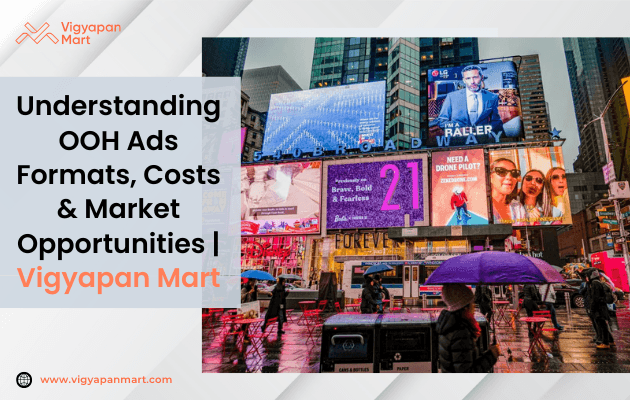
Out-of-home (OOH) advertising is any paid brand message people meet outside their homes: billboards, bus and metro branding, airport screens, street furniture, retail stores and village walls. In India it gives brands mass, local and regional reach, while digital OOH adds flexible, data-led messaging. This guide covers formats, examples, cost factors, trends and how to plan a campaign.
At a Glance: OOH Formats in India
| OOH Format | Typical Use | Suitable For | Cost Drivers |
|---|---|---|---|
| Billboards | Mass awareness | FMCG, automotive, real estate, telecom, BFSI | Location, size, duration, visibility |
| Metro | Commuter reach | Consumer brands, services, launches | Station, route, format, duration |
| Bus | Mobile urban reach | FMCG, retail, local brands | Route, bus type, branding area |
| E-rickshaw | Hyperlocal reach | Local and regional brands | Fleet size, geography, duration |
| Airport | Premium audiences | Luxury, BFSI, technology, travel | Airport, placement, format |
| DOOH | Dynamic awareness | Brands needing flexible messaging | Screen, impressions, location, duration |
| Supermarket/Retail | Point-of-purchase influence | FMCG, food, consumer brands | Store network, placement, footfall |
| Rural OOH | Regional penetration | FMCG, agriculture, consumer durables | Geography, media type, coverage |
What Is OOH Advertising?
Quick Answer: OOH stands for out-of-home advertising: paid brand communication delivered to people while they are away from home, on the street, in transit, in stores or in public venues.
The terms overlap, so here is how they relate:
- Outdoor advertising is the classic core: billboards, hoardings, wall paintings and street-level media. Outdoor advertising in India is the largest and oldest part of the category.
- Transit advertising sits inside OOH and covers buses, metro, airports and taxis.
- DOOH (digital out-of-home) is OOH delivered on digital screens, including digital billboards, with scheduled or dynamic content.
- Retail or in-store advertising covers supermarkets, malls and other places where purchase decisions happen.
In short, OOH includes billboards, transit, street furniture and DOOH. The rest of this guide follows that structure.
Why OOH Advertising Matters in India in 2026
OOH matters in India because it reaches people while they commute, shop and travel, and because it is currently the one traditional medium forecast to keep growing.
Some of the current data:
• Dentsu’s 2026 Digital Advertising Report describes OOH as the only traditional medium projected to grow, at a CAGR of 3% through 2027, supported by digital OOH networks and urban infrastructure upgrades.
• EY’s analysis found that India’s OOH segment grew 10% in 2024 to INR 5,920 crore, covering traditional, transit and digital media.
• Not every estimate agrees. The Pitch Madison Advertising Report 2025 puts OOH revenue at Rs 4,650 crore in 2024. Industry sizing differs by methodology, so treat any single figure as an estimate.
• Globally, Dentsu forecasts OOH to expand 4.1% in 2026, with digital OOH gaining traction as standalone inventory in several markets.
Practical reasons marketers keep OOH in the mix:
• Mobility and commuting: Bus, metro and airport media reach people on repeat routes, which builds frequency.
• Local and regional control: Brands can concentrate spend in specific cities, corridors or neighbourhoods.
• Digital integration: QR codes, branded search and paid social can turn physical exposure into trackable journeys.
• Data-led planning: Location and mobile data are being used more heavily to plan and justify placements.
Types of OOH Advertising in India
Billboard Advertising
Billboard advertising uses large static or digital panels on roads, junctions, highways and commercial areas to build mass awareness.
• Static billboards and hoardings are printed panels displayed continuously, often lit at night.
• Digital billboards rotate several advertisers or creatives on an LED screen.
• Premium locations typically mean high-traffic junctions, arterial roads and highways.
Pricing varies widely by city, site and format, so any “average rate” is misleading. The cost section below explains the drivers behind billboard advertising cost in India. For location logic, see VMPL’s guide to the best locations for billboard advertising and its tips to increase impressions with a billboard ad. VMPL also offers billboard advertising services.
Metro Advertising
Metro advertising places brand messages inside and around metro networks, where commuters are a captive, repeat audience.
Typical formats:
• Station branding, including entry and exit points and platform panels
• Train wraps and interior branding
• Digital screens
• Station domination, where one brand takes over multiple placements in a station
It suits launches and service brands that need concentrated, repeated visibility in a city. For cost comparisons, see VMPL’s breakdown of transit advertising costs for metro vs intra-city.
Bus Advertising in India
Bus advertising in India means branding buses, shelters and stops so a message travels across a city on fixed routes.
Formats include:
• Full bus wraps
• Partial wraps
• Side and rear panels
• Bus shelter and bus stop advertising
• Digital screens on shelters or inside buses
When people search for “best bus advertising”, the honest answer depends on the objective. Route selection, bus type and creative fit usually matter more than format alone. Times OOH launched twenty digital bus shelters in Bengaluru in January 2025, which shows how shelters are moving toward dynamic content.
Go deeper with these VMPL guides: bus advertising strategies in India, full wraps vs partial panels and viral transit campaigns.
E-Rickshaw Advertising
E-rickshaw advertising brands electric rickshaws that run fixed local routes, giving neighbourhood-level visibility at relatively small geographic scale.
They work well for:
• Hyperlocal campaigns around a store, clinic, coaching centre or dealership
• Regional launches in dense areas where larger transit media is not practical
• Local and regional brands, and categories such as education, retail and services
Cost depends on fleet size, geography and duration, not on a single standard rate. VMPL’s explainer on what e-rickshaw advertising is and its piece on benefits for local businesses cover the details.
Airport Advertising
Airport advertising places brands inside terminals and on approach roads, where audiences are travellers with higher dwell time and, often, higher spending power.
Common placements are terminal branding, baggage belts, arrival and departure areas, and digital screens. It fits luxury, BFSI, technology and travel brands. Airports are also a premium environment, so creative quality matters more than in a busy street setting.
Street Furniture Advertising
Street furniture advertising uses public utility structures such as bus shelters, benches, kiosks and pillars to reach pedestrians and local traffic.
It is a pedestrian-scale format, strong for local awareness and repeated exposure along walking routes. VMPL lists street furniture advertising services alongside its other OOH offerings.
Supermarket and Retail Advertising
Supermarket advertisements are brand messages placed inside or around supermarkets and grocery stores, reaching shoppers close to the point of purchase.
Retail advertising is broader and includes supermarkets, malls and in-store media. Advertising in supermarkets typically uses:
• Entrance branding
• Shelf branding
• Shopping cart advertising
• Checkout advertising
• In-store screens
• Point-of-sale (POS) communication
It also connects to retail media networks, where retailers sell ad inventory using their own shopper data. Dentsu’s global forecast names retail media as the fastest-growing digital channel, at 14.1% growth in 2026.
OOH and retail work together in sequence. Outdoor media builds awareness and consideration, and in-store media reminds and converts at the shelf. VMPL’s guides cover both angles: what supermarket advertising is, its benefits and retail media networks.
Rural Advertising in India
Rural advertising reaches villages and small towns through local media, so brands can build awareness where mass digital and TV reach may be uneven.
It helps to separate two ideas:
• Rural OOH is the outdoor layer: wall paintings, village-level hoardings and transport branding.
• Rural marketing is the wider approach, including distribution, sampling, demonstrations and community activation.
Common tactics for advertising in rural areas:
DOOH: Digital Out-of-Home Advertising
DOOH is OOH delivered on digital screens, allowing scheduled content, dynamic creative and, increasingly, audience-data and programmatic buying.
DOOH includes digital billboards, transit and retail screens, and programmatic OOH (pDOOH). Its main advantages:
• Time-based messaging, such as different creatives by daypart
• Contextual triggers, such as weather or events
• Faster changes, since there is no reprinting
• Better reporting, when audience or impression data is available
Scale is still building. EY estimated about 185,000 digital screens in India in 2024, with 75% in the top 12 metro cities, and projected DOOH’s share of OOH revenue to rise from 12% to 17% by 2027. VMPL’s guides on the rise of digital billboards and programmatic OOH go further, and VMPL offers DOOH advertising services.
OOH Advertising Examples in India
Each example below is tied to a source. Where the source describes infrastructure or a model rather than a campaign result, that is stated.
Notable OOH Campaigns and Marketing Examples
| Brand | OOH Format | Campaign Idea and Context | Why Notable | Marketing Takeaway |
|---|---|---|---|---|
| Uniqlo | 3D anamorphic outdoor installation | Store launch by WPP Media | Listed as a Gold winner at the OOH Advertising Awards | Format innovation can turn a launch into a talked-about landmark |
| Xiaomi India (Redmi Note 14 Pro+ 5G) | DOOH | Digital execution for a product launch | Appears in the awards winners list under an innovative DOOH category | DOOH suits launches that benefit from motion and timing |
| Times OOH | Digital bus shelters | Twenty shelters launched in Bengaluru, January 2025 | Infrastructure example, not a campaign result | Transit furniture is going digital, widening commuter-targeting options |
| Tirutapi Edible Oils | Digital billboards | Festive campaign with Times OOH in Ahmedabad, October 2024 | Regional brand using digital formats in an emerging market | Digital formats are no longer limited to national advertisers |
| Hindustan Unilever | Rural distribution model (not OOH) | Project Shakti, piloted in 2002 in 50 Andhra Pradesh villages with self-help groups | Long-running rural marketing case | Rural marketing works best when media, distribution and community trust support each other |
| Asian Paints and Hyundai | Rural activations | Painting a village head’s house as a live demo; a caravan visiting 418 rural areas (per VMPL’s rural marketing roundup) | Demonstration-led rural trust building | Demonstration builds trust where advertising alone may not |
Editor note: no verified supermarket or metro campaign with a citable primary source was found during research. Add one before publishing if the team has approved client material.
How Much Does OOH Advertising Cost in India in 2026?
There is no single national price for OOH advertising in India. Cost depends on city, location, format, size, visibility, duration, production and the media owner.
Current, citable price ranges from credible sources could not be verified, so this article lists cost drivers rather than numbers. Any rate quoted without a city, format, date and source (and without saying whether production and installation are included) should not be treated as a 2026 price. That applies to billboard advertising cost in India, bus advertising cost and transit advertising cost alike.
Key Factors That Affect OOH Advertising Costs
| Cost Factor | How It Affects Price |
|---|---|
| City and market tier | Metro markets and premium zones generally cost more than smaller cities |
| Location and visibility | High-traffic junctions, clear sightlines and long viewing distance raise cost |
| Media format | Static, digital, wrap, shelter, in-store and wall media are priced differently |
| Size | Larger panels or wraps cost more |
| Traffic and audience | Higher commuter or footfall volumes raise demand |
| Duration | Longer bookings may lower monthly cost but raise total spend |
| Production and printing | Material, lighting and creative adaptation add cost |
| Installation and maintenance | Height, structure and upkeep affect the quote |
| Permissions | Local approvals and site rules can add time and cost |
| Media owner | Rate cards and negotiability differ |
| Campaign scale | Multi-city or multi-format buys change unit pricing |
| Digital impressions (DOOH) | Screen loop length, share of time and audience data affect pricing |
For format-specific context, see VMPL’s transit advertising cost breakdown. When asking for a quote, request the specific site or route, the exact duration, and what is included.
How to Choose the Right OOH Services for Your Brand
OOH services should be chosen by matching audience, geography and objective first, then format, then location.
Evaluate these twelve points:
1. Audience: who they are and where they move
2. Geography: cities, corridors or villages
3. Objective: awareness, launch, footfall or lead generation
4. Format: which media fits the objective
5. Reach and frequency: one big exposure or repeated routes
6. Location quality: visibility, clutter and viewing time
7. Duration: long enough for recall
8. Creative suitability: readable at speed or at a glance
9. Production needs: materials and lead time
10. Measurement: what will be tracked and how
11. Reporting: proof of display and updates
12. Digital integration: QR codes, search and paid support
For a wider view of service categories, see VMPL’s guide to must-know OOH services.
If you are planning an OOH campaign and need help selecting formats, locations or execution, explore Vigyapan Mart’s OOH advertising services.
OOH vs Digital Advertising
OOH and digital advertising do different jobs. OOH offers physical, unskippable visibility, while digital offers targeting depth and direct measurement.
OOH vs Digital Advertising
| Factor | OOH | Digital |
|---|---|---|
| Reach | Broad, location-based | Broad, platform-based |
| Targeting | By place, route and time | By audience, behaviour, interest |
| Physical visibility | High | None |
| Frequency | Built through repeat routes | Controlled by platform settings |
| Creative flexibility | Static: low. DOOH: high | High |
| Real-time optimisation | Limited (DOOH: moderate) | High |
| Measurability | Estimated exposure plus proxies | Direct clicks and conversions |
| Geographic targeting | Very precise for fixed sites | Precise, but not tied to physical presence |
| Conversion tracking | Indirect | Direct |
| Brand awareness | Strong | Strong, but competes with feed clutter |
Neither is universally better. Integrated campaigns pair physical visibility with measurable digital journeys, for example a billboard with a QR code and supporting paid search. See VMPL’s comparison of outdoor and digital advertising effectiveness.
Is OOH Advertising Still Relevant in 2026?
Yes. OOH remains relevant in 2026, and it is one of the few traditional media forecast to grow, but it works best as part of a measured, integrated plan.
The evidence, with sources:
• Dentsu’s forecast (above) has OOH growing while other traditional media recalibrate.
• Mordor Intelligence estimated static OOH at a 67.30% revenue share of India’s OOH and DOOH market in 2025, with transit forecast to grow faster than billboards.
• IMARC valued India’s digital OOH market at USD 2.43 billion in 2025 and forecast an 11.39% CAGR for 2026 to 2034. Market-research firms differ sharply on absolute values, so read these as directional.
Where OOH is changing: DOOH, programmatic buying, retail media, hyperlocal targeting and QR-linked journeys. For VMPL’s view of the evidence, see proof that outdoor advertising still works.
How to Plan an OOH Campaign in India
1. Define the objective. Awareness, launch, footfall or leads. This decides everything else.
2. Define the audience. Demographics, but also movement patterns.
3. Select markets. Prioritise cities or regions by audience density and business relevance.
4. Map audience movement. Identify commute routes, shopping zones and dwell points.
5. Select formats. Match format to objective (see the objective table below).
6. Shortlist locations. Check visibility, viewing time, clutter and traffic direction.
7. Develop creative. Short copy, strong contrast, one idea, large brand mark.
8. Plan production and installation. Allow lead time for printing, approvals and installation.
9. Launch and monitor. Verify display with photos and reports.
10. Measure and optimise. Review proxies and adjust in flight where possible, especially on DOOH.
How OOH Campaigns Can Be Measured
OOH measurement combines estimated exposure with indirect and direct response signals. Exposure numbers are estimates. Digital conversions are directly attributable only when the journey passes through a trackable step.
• Exposure metrics: estimated impressions, reach, frequency and traffic
• Physical response: footfall and store visits
• Direct response: QR scans, unique URLs, promo codes and call tracking
• Indirect signals: website visits, branded search lift and social mentions
• Advanced: geo-lift tests comparing exposed and non-exposed markets
• Business correlation: leads or sales compared with a baseline
Do not present correlation as proof of exact attribution. Use test-and-control designs where the budget allows.
OOH Advertising by Business Objective
| Objective | Recommended Formats |
|---|---|
| Mass awareness | Billboard, DOOH, transit |
| Local awareness | E-rickshaw, bus, street furniture |
| Product launch | Billboard, metro, DOOH |
| Retail footfall | Mall, supermarket, nearby OOH |
| Rural penetration | Rural OOH, wall media, local transit |
| Premium branding | Airport, premium DOOH |
| Regional campaign | Bus, e-rickshaw, local OOH |
| Digital amplification | DOOH + QR + paid digital |
How to Choose an OOH Advertising Company in India
Choose an OOH company on inventory access, planning capability, execution reliability and transparent reporting, not on claims of being the biggest.
Ask about:
• media inventory and geographic reach
• location planning and media buying method
• creative support and production
• installation, monitoring and proof of display
• reporting format and turnaround
• DOOH, transit and rural capability
• integration with digital marketing
• pricing transparency, including what is included in a quote
Compare at least two proposals on the same brief, and ask for site-level detail.
Why Brands Work With Vigyapan Mart
Based on Vigyapan Mart’s website, the agency offers OOH and outdoor services that include billboards, digital billboards, metro station and train advertising, auto advertising, street furniture, unipoles, wall paintings and wraps, DOOH, outdoor signage and door-to-door activation. It also lists in-house creative support, handling of permits and approvals, and installation and maintenance. Its stated approach begins with brand objectives, ground surveys and competition analysis.
VMPL’s site also lists testimonials from brands such as CRI Pumps, Wonder Cement, Luminous and Reliance. These are client statements, not verified campaign results.
Explore the full OOH and outdoor advertising services, or the dedicated pages for billboards and DOOH.
People Also Ask
What is OOH advertising?
OOH (out-of-home) advertising is paid brand communication that reaches people outside their homes, through billboards, transit media, street furniture, retail environments and digital screens. In India, it gives brands mass, local and regional reach across cities, highways and villages.
What are examples of OOH advertising in India?
Examples of OOH advertising in India include digital billboards, metro station branding, bus wraps, digital bus shelters, airport screens, supermarket branding and village wall paintings. Brands such as Uniqlo and Xiaomi have used 3D installations and DOOH for launches, while regional brands use digital billboards for festive campaigns.
What are the types of OOH advertising?
The main types of OOH advertising are billboards, transit media (bus, metro, airport and taxi), street furniture, retail and in-store media, rural OOH and digital out-of-home (DOOH). Each format suits a different objective, from mass awareness to hyperlocal reach.
How much does billboard advertising cost in India?
Billboard advertising cost in India has no single standard price. It depends on the city, site visibility, size, format (static or digital), duration, production and installation, and the media owner. Request a site-specific quote that states the booking period and what is included.
What is the cost of billboard advertising in India for a small business?
Small businesses can lower billboard advertising cost by choosing a smaller or local format, a shorter booking period or a targeted area instead of a premium junction. Compare quotes for two or three alternatives, and confirm whether printing and installation are included.
What is bus advertising in India?
Bus advertising in India is the branding of buses, shelters and bus stops, using full or partial wraps, side and rear panels, and digital shelter screens. The message travels along fixed city routes, giving repeated exposure to commuters and pedestrians.
Subscribe to our newsletter
Get updates instantly! Join our community for the latest marketing insights.