
What Makes a Billboard Campaign Work Across Multiple Cities With Different Audiences?
A multi-city billboard campaign is not about copying one ad everywhere. This guide explains how to adapt one core brand idea for different audiences in Mumbai, Delhi, Bengaluru, Pune and Hyderabad, covering location choice, simple creatives, reach and frequency planning, and campaign measurement.
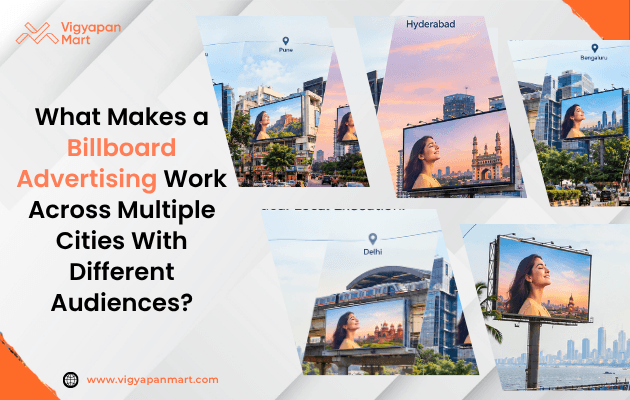
Running one billboard campaign across multiple cities sounds simple. All you need to put the ad creatives in Mumbai, Delhi, Bengaluru, Pune, Hyderabad, and many other markets and done.
But no. Cities don’t work the same way.
A message that works for a Mumbai commuter may not create the same response in Lucknow. A premium product may need a different context in Bengaluru than in Jaipur. Even within one city, audiences can differ sharply between an airport road, residential neighbourhood and commercial market.
This makes multi-city OOH advertising less about repeating one advertisement and more about creating one brand idea that can adapt to different audiences.
India's OOH market is growing strongly. India’s OOH Media grew 13% in 2025, while Digital OOH was around 18% of the total OOH revenue.
Source URL: ( EY)
What Makes a Multi-City Billboard Campaign Work?
Quick Answer
A billboard campaign works across multiple cities when the core brand message stays consistent, while language, creative, formats, and locations are adapted to each city's audience. Clear campaign goals, local audience research (commute patterns, culture, language), the right mix of formats like hoardings, digital screens, metro and transit media, and city-wise performance tracking help determine campaign results.
Billboard Advertising
Billboard advertising is a form of outdoor advertising that displays brand messages, images, offers or promotional content on large-format advertising boards.
1. Keep One Core Brand Message:
The very first rule is to stay consistent. A single advertisement campaign must stay consistent around one central idea. People should recognise it everywhere. Use the same
- Headline
- Visual Language
- Campaign
- Brand Identity
But consistency doesn’t mean that all your billboards must look identical.
For example:
A food brand must use the same idea but with different cultural moments, local references, and different product preferences according to market.
The audience should feel:
“This is the same campaign.”
But not:
“This advertisement was simply copied and pasted here.”
The solution is to maintain a balance between consistency and local relevance.
2. Understand Each City's Audience
Cities have different demographics, income levels, commuting patterns, languages and consumption habits. Before installing a billboard, map your audience first.
Marketers should examine:
- Who lives and works around the location?
- Where do they travel?
- What time do they travel?
- What is the traffic speed?
- Is the location residential, commercial, transit-led, or more of entertainment?
- What is the purchasing behaviour of this location?
The objective is to buy relevant audience exposure, not just billboard space.
3. Localise Without Losing the Brand:
Localisation makes your ad campaign more relevant to local places. A good billboard ad should include:
- Local Language
- City-Specific Humour
- Cultural References
- Local Landmarks
- Contextual Offers
But localisation should support the central campaign idea. Your localisation should not overshadow the main ad messages.
Hoarding advertising displays brand messages, images, offers or promotional content on large advertising structures placed in high-visibility outdoor locations.
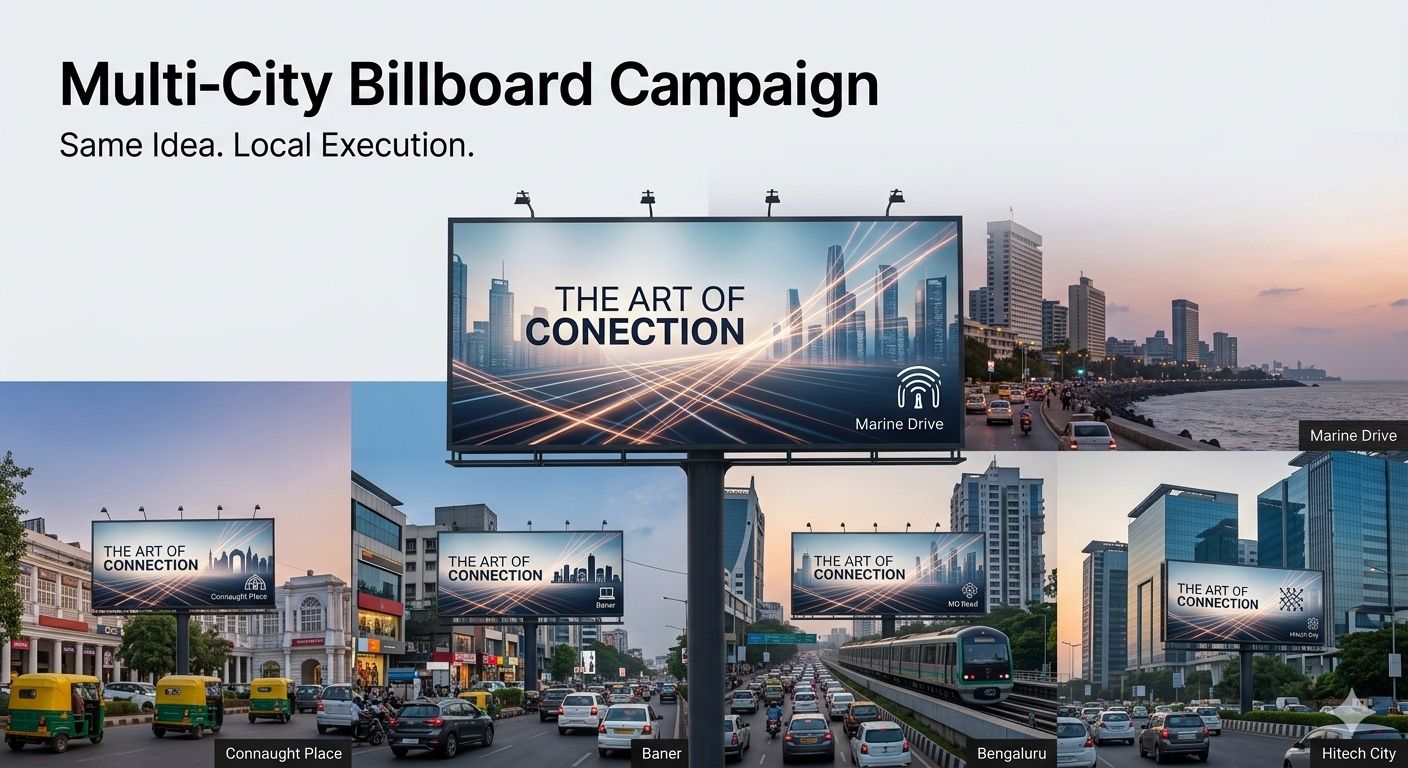
4. Choose Locations Based on Behaviour, Not Prestige:
A good billboard interactive outdoor advertising generates huge visibility, but visibility alone is not enough today. It's not a guarantee of effectiveness. A strong multi-city advertisement considers how people interact with the location and its people’s behaviour.
A billboard at a high-speed road and a traffic signal need different approaches.
For example:
An airport billboard can support contextual storytelling because people there have more dwell time. But a billboard on highways needs instant curiosity and recognition.
A metro environment can use sequential or digital messaging.
This becomes increasingly important as India's OOH inventory becomes more sophisticated.
Plus, the rise of DOOH advertisements is also giving brands more opportunities to change creative according to location, time and context.
The Digital OOH ad market may reach 44.1% of the total Indian OOH advertising market by 2029.
5. Make the Creative Work in a Few Seconds
People do not stop their commute to read a billboard. The message has to communicate quickly. A good billboard advertisement agency considers reach, resonance and reaction when evaluating marketing effectiveness.
For a billboard, this means the ads should have:
- A short headline
- Strong brand visibility
- One clear message
- High visual contrast
- Minimal unnecessary information
- A simple call to action where required
This becomes even more important when the campaign runs across cities because every location can offer a different viewing environment.
For example:
- A driver needs instant communication.
- A commuter at a metro station advertising can process more information.
The creative should fit the viewing situation.
6. Use Data to Plan Reach and Frequency
A national campaign should not simply divide the budget equally among cities.
Mumbai may require a different investment from Chandigarh.
Delhi may need a different mix of premium and mass-reach locations from Ahmedabad.
The right question is:
Where can the brand achieve meaningful reach and sufficient frequency among its target audience?
Measurement is becoming increasingly important here. Players like Vigyapan Mart in India's OOH industry have been moving towards stronger audience measurement, including GPS-based approaches.
Better measurement allows advertisers to move from simply counting sites to understanding audiences and impressions.
7. Connect Billboard Exposure with Digital
A billboard does not have to end when someone leaves the location. A strong multi-city campaign can connect OOH with social media, search, QR codes, influencers and digital content.
For example:
A brand can use a city-specific billboard to create curiosity and then use social media to continue the story. DOOH can also change messages based on time, location or context.
This matters because consumers increasingly move between physical and digital environments.
8. Measure the Campaign as One System
Finally, brands should evaluate a multi-city billboard campaign at two levels.
- Nationally:
Did the campaign build reach, awareness and brand consistency?
- Locally:
Did each city's media plan reach the intended audience and generate the required response?
This prevents one city with exceptional performance from hiding weak planning in another.
Transit Advertising
Transit advertising is a form of outdoor advertising that communicates brand messages through advertising media associated with public transportation systems, including buses, metros and trains.
How Can Vigyapan Mart Help With Billboard Advertising?
Vigyapan Mart helps brands build multi-city billboard campaigns that balance consistent branding with local audience relevance.
Our team handles location planning, media selection, creative adaptation and campaign execution to help brands reach the right audiences across different markets.
Conclusion:
A billboard campaign can work across multiple cities when brands standardise the idea but localise the execution.
The strongest campaigns combine a consistent brand message with city-level audience understanding, location-specific media planning, simple creative, appropriate frequency and measurable outcomes.
India's OOH market is already moving in this direction. OOH grew 13% in 2025, while digital OOH's share reached 18% of segment revenues.
Multi-city billboard advertising is not about putting the same advertisement everywhere. It is about making the same brand idea feel relevant everywhere.
Looking for an expert team to launch billboard advertising in Delhi NCR? Connect with Vigyapan Mart OOH advertising agency today.
Frequently Asked Questions
Subscribe to our newsletter
Get updates instantly! Join our community for the latest marketing insights.