
Metro Advertising vs Digital Advertising: Complete Guide for Brands in India (2026)
When brands plan a marketing campaign, one question often comes up: Should we invest in metro advertising or digital advertising?
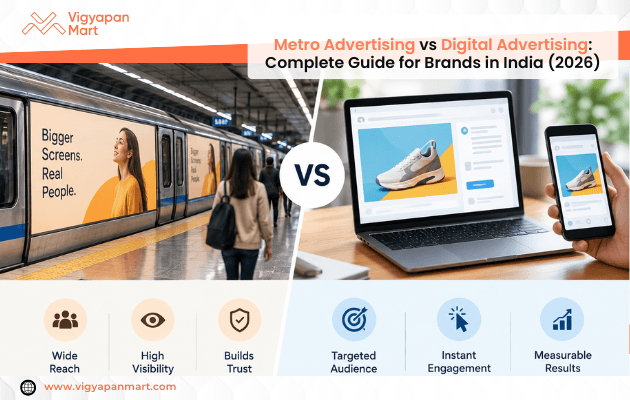
Both channels can build awareness and reach potential customers, but they work very differently.
Metro advertising places a brand physically inside the daily commute on trains, platforms, pillars, escalators, gates, concourses and digital screens.
Digital advertising reaches people through online platforms such as Google, YouTube, websites, apps and social media, with targeting and campaign optimisation based on audience and performance signals.
The right comparison is therefore not simply metro vs digital. It is about where your audience spends attention, what you want them to do, how precisely you need to target them, and how you want to measure the campaign.
This guide compares metro advertising and digital advertising across formats, costs, targeting, visibility, measurement, advantages, limitations and campaign objectives.
Transit advertising
Transit advertising is out-of-home advertising on buses, metro trains, stations, taxis, auto-rickshaws, airports and bus shelters, reaching people on their daily commute for city-wide awareness and repeated exposure. Looking for the best transit advertising services in India? Vigyapan Mart plans campaigns across all these formats.
Metro Advertising vs Digital Advertising: Quick Comparison
| Factor | Metro Advertising | Digital Advertising |
|---|---|---|
| Medium | Physical/transit OOH | Online |
| Main environments | Metro stations, trains, platforms, concourses | Search engines, websites, apps, social platforms, video platforms |
| Audience | Commuters within selected metro networks | Digitally reachable audiences |
| Targeting | Location, station, route, network, commuter environment | Keywords, demographics, interests, behaviours, location, remarketing and other platform signals |
| Cost model | Media inventory, format, location and campaign duration | CPC, CPM, CPV, CPA or other bidding models depending on campaign |
| Visibility | Physical and unavoidable within the selected environment | Depends on placement, targeting, auction and user behaviour |
| Creative formats | Train wraps, station branding, panels, pillars, digital screens, experiential formats | Search, display, social, video, native and other digital formats |
| Measurement | Estimated exposure, footfall, campaign monitoring, QR/URL response and other measurement methods | Impressions, clicks, CTR, conversions, CPA, ROAS and other platform metrics |
| Campaign flexibility | Physical production and installation can require planning | Creative, targeting and budgets can usually be changed more quickly |
| Best suited for | Urban awareness, launches, mass visibility, location-based branding | Traffic, leads, conversions, remarketing and measurable online actions |
| Major limitation | Less granular individual-level targeting | High competition and dependence on digital platforms and user behaviour |
What Is Metro Advertising?
Metro advertising is a form of transit and OOH advertising where brands use advertising spaces across metro trains and stations.
Common formats include:
- Train wraps
- Platform branding
- Station panels
- Pillar branding
- Escalator branding
- Staircase branding
- Entry and exit gate branding
- Floor graphics
- Digital LED screens
- Video walls
- Concourse advertising
- Experiential installations
Metro advertising can create repeated exposure because commuters often follow similar routes and stations during their daily journeys.
For example, a campaign can be designed around a particular metro line, a group of stations, interchange points or premium locations depending on the campaign objective.
Vigyapan Mart's existing metro advertising guide covers these formats and the major factors that influence metro advertising costs, including city, station category, format, duration, production and installation.
What Is Digital Advertising?
Digital advertising is paid promotion delivered through internet-connected platforms.
Major digital advertising environments include:
- Google Search
- Google Display
- YouTube
- Social media platforms
- Websites
- Mobile applications
- Online video
- Remarketing platforms
Digital advertising can be optimised toward different objectives such as clicks, views, leads, conversions or revenue.
For example, Google Ads uses an auction system where factors such as bid, ad quality, landing-page experience, context and competition influence ad placement. The actual CPC can be lower than the maximum CPC bid.
This makes digital advertising fundamentally different from buying a fixed physical advertising location.
Metro Advertising vs Digital Advertising: How Do They Work?
How Metro Advertising Works
A typical metro advertising campaign involves:
1. Defining the campaign objective
2. Identifying the target city
3. Selecting metro networks or stations
4. Choosing advertising formats
5. Checking available inventory
6. Designing campaign creatives
7. Producing the required materials
8. Installing the advertisements
9. Monitoring campaign execution
10. Measuring campaign response
For example, a brand launching in Delhi NCR could combine station branding with train advertising around relevant commuter routes.
How Digital Advertising Works
A digital campaign generally involves:
1. Defining the marketing objective
2. Identifying the target audience
3. Selecting platforms
4. Creating campaigns and ad groups
5. Preparing creatives and landing pages
6. Setting budgets and bidding strategies
7. Launching campaigns
8. Tracking impressions, clicks and conversions
9. Optimising campaigns
10. Scaling or reducing spend based on results
Google provides multiple bidding approaches depending on the objective, including CPC, viewable CPM, CPV and conversion-focused strategies.
Metro Advertising vs Digital Advertising: Cost Comparison
There is no universal price for either channel.
Metro advertising is generally priced according to media inventory, city, station, format, campaign duration, production and installation requirements.
Digital advertising is generally influenced by campaign objective, audience, competition, bid strategy, platform, creative quality and conversion economics.
| Cost Factor | Metro Advertising | Digital Advertising |
|---|---|---|
| Media buying | Fixed inventory/package based | Auction/bidding based in many formats |
| Primary pricing basis | Location + format + duration | CPC, CPM, CPV, CPA or other campaign model |
| Creative production | Printing/wrapping/installation may apply | Creative/video/landing-page production may apply |
| Location premium | Strong influence | Location targeting influences auction and delivery |
| Audience competition | Reflected in inventory pricing | Can increase auction costs |
| Campaign duration | Often booked for defined periods | Budget can generally be adjusted continuously |
| Scalability | Requires additional inventory | Budget and targeting can usually be scaled digitally |
| Measurement cost | May require additional tracking/measurement | Platform and analytics tracking are built into many campaigns |
Billboard advertising cost in India
Billboard advertising cost in India depends on the city and location, billboard size and format (static or digital), traffic and visibility, lighting, campaign duration, and production and installation needs. Prime locations in metro cities cost more than tier-2 and tier-3 locations. Costs are quoted per site and duration, so the final price depends on your plan.
Example Metro Advertising Costs
Current figures published on VMPL's transit advertising content show examples such as:
- Metro train wrap: approximately ₹5–10 lakh/month
- Metro station panel: approximately ₹2–4 lakh/month
- Metro digital screen: approximately ₹3–6 lakh/month
These should be treated as indicative examples rather than fixed India-wide rates, because actual pricing depends on the city, metro network, station, inventory, format, duration and commercial terms.
Digital advertising does not have an equivalent fixed “monthly metro slot” price. For example, Google Ads explains that actual CPC is influenced by auction competition, Ad Rank, ad quality, context and other factors.
Metro Advertising: Pros and Cons
Advantages of Metro Advertising
1. Strong physical visibility
Metro advertising puts the brand into the commuter's physical environment instead of competing only for screen attention.
2. Repeated exposure
Regular commuters may encounter the same station, route or advertising environment repeatedly.
3. Strong urban presence
Metro networks can be useful for brands seeking visibility in major urban markets.
4. Multiple creative formats
Brands can combine train wraps, station panels, pillars, escalators and digital screens within one campaign.
5. Brand-building potential
Large-format physical advertising can help create a strong visual presence around a launch or city campaign.
6. Offline-to-online integration
QR codes, short URLs and campaign-specific landing pages can connect metro campaigns with digital journeys.
Limitations of Metro Advertising
- Individual-level targeting is more limited than many digital platforms.
- Physical production and installation require planning.
- Creative changes are not as immediate as changing an online ad.
- Availability depends on inventory.
- Measuring direct conversions can be more challenging.
- Premium stations and formats can require larger budgets.
Digital Advertising: Pros and Cons
Advantages of Digital Advertising
1. Detailed targeting options
Digital platforms can use signals such as location, keywords, audience characteristics, interests or behaviours depending on the platform and campaign type.
2. Measurable actions
Digital campaigns can directly track metrics such as clicks, conversions and cost per conversion when tracking is properly implemented.
3. Flexible budgets
Campaign budgets and bids can be adjusted during the campaign.
4. Fast creative changes
A digital creative can generally be replaced much faster than a physical metro installation.
5. Remarketing
Digital campaigns can reconnect with users who previously interacted with a website or digital property, subject to platform eligibility and privacy requirements.
6. Conversion-focused campaigns
Digital advertising can be configured toward objectives such as clicks or conversions. Google, for example, supports bidding approaches designed around clicks, impressions, views and conversions.
Limitations of Digital Advertising
- Users can scroll past or ignore ads.
- Competition can increase advertising costs.
- Performance depends heavily on creative, audience, offer and landing-page quality.
- Ad fatigue can occur when users repeatedly see the same creative.
- Results can fluctuate as auction conditions change.
- Digital campaigns require accurate tracking to evaluate performance properly.
Metro Advertising vs Digital Advertising: Which One Should a Brand Use?
Instead of asking which medium is universally better, start with the campaign objective.
| Marketing Objective | Metro Advertising | Digital Advertising |
|---|---|---|
| City-wide brand visibility | Strong use case | Strong use case |
| Product launch | Strong use case | Strong use case |
| Hyper-local online targeting | Limited | Strong use case |
| Website traffic | Can support through QR/URL | Strong use case |
| Lead generation | Can support indirectly | Strong use case |
| Brand recall | Strong use case | Depends on campaign exposure and creative |
| Retargeting | Limited | Strong use case |
| Physical retail presence | Strong use case | Can support |
| Commuter audience | Strong use case | Can target digitally but not the physical journey |
| Immediate creative optimisation | Limited | Strong use case |
| Offline + online campaign | Strong when integrated | Strong when integrated |
Metro Advertising vs Digital Advertising for Brand Awareness
Metro advertising can create a physical brand presence, particularly when the campaign occupies multiple touchpoints across a commuter journey.
Digital advertising can generate repeated online exposure across selected audiences and platforms.
For a brand launch, these channels can also work together.
For example:
Metro → Awareness → QR/URL → Landing Page → Digital Remarketing → Lead/Conversion
This creates a connected customer journey instead of treating OOH and digital as completely separate channels.
Can Metro Advertising and Digital Advertising Work Together?
Yes, In many campaigns, the strongest strategy is not choosing one channel but connecting both.
A simple integrated campaign could look like:
Stage 1 - Metro Awareness
Use:
- Train wraps
- Station branding
- Platform panels
- Digital metro screens
Goal: Build physical visibility.
Stage 2 - Digital Amplification
Use:
- Google Ads
- YouTube
- Display
- Remarketing
Goal: Continue the conversation online.
Stage 3 - Conversion
Send interested users to:
- Landing page
- Product page
- Store locator
- Lead form
- App download page
Stage 4 - Measurement
Track:
- QR scans
- Dedicated URLs
- Landing-page traffic
- Leads
- Calls
- Search-volume changes
- Brand-search activity
- Digital campaign conversions
This approach connects physical visibility with measurable digital actions.
Metro Advertising Formats Brands Can Explore
The entire or selected portion of a metro train is branded.
Best suited for:
- Large launches
- Consumer brands
- City-level awareness
- High-impact campaigns
2. Station Branding
Brands can use multiple advertising surfaces within a station.
These can include:
- Pillars
- Walls
- Gates
- Platforms
- Escalators
- Staircases
- Concourse areas
3. Digital Metro Screens
Digital screens can support video, motion graphics and dynamic creative.
VMPL's current metro content also highlights the growing role of digital screens, data-driven targeting and programmatic DOOH in metro environments.
Brands can create immersive station experiences instead of relying only on standard posters.
This can be particularly relevant for:
- Product launches
- Entertainment
- Consumer technology
- Automotive
- FMCG
- Fashion
- Education
Types of Digital Advertising
Digital advertising is a broad category.
Search Advertising
Ads appear when users search for relevant terms.
Useful for capturing existing intent.
Social Media Advertising
Brands can distribute visual, video, carousel and other formats across social platforms.
Display Advertising
Banner and visual advertising can appear across participating websites and digital environments.
Video Advertising
Video campaigns can run across video platforms and other digital inventory.
Remarketing
Brands can reconnect with eligible audiences who have previously interacted with their digital properties.
How to Measure Metro Advertising
Metro campaigns require a different measurement framework from digital campaigns.
Useful measurement methods include:
1. Estimated audience exposure
Use available media/traffic estimates for the selected inventory.
2. Footfall data
Evaluate station or location traffic where reliable data is available.
3. QR codes
Use campaign-specific QR codes.
4. Dedicated landing pages
Create a campaign-specific URL to distinguish responses.
5. Search behaviour
Monitor changes in branded search activity during the campaign, while accounting for other marketing activity.
6. Lead tracking
Use dedicated phone numbers, forms, QR codes or campaign-specific landing pages.
7. Brand studies
For larger campaigns, consider pre/post or exposed-vs-control research where feasible.
How to Measure Digital Advertising
Digital campaigns provide a broader set of directly observable platform and analytics metrics.
Common metrics include:
- Impressions,
- Reach
- Clicks
- CTR
- CPC
- CPM
- Conversions
- CPA
- Conversion rate
- Revenue
- ROAS
However, measurement quality depends on correct implementation of analytics, conversion tracking and attribution.
Metro Advertising vs Digital Advertising: 7 Key Differences
1. Physical vs Digital
Metro advertising exists in the physical environment. Digital advertising exists within online platforms and properties.
2. Location vs Audience Targeting
Metro campaigns primarily select where the advertising appears. Digital campaigns can use various audience and contextual signals to determine who should receive an ad.
3. Fixed Inventory vs Auction-Based Delivery
Metro media is commonly purchased around defined locations, formats and durations. Digital advertising can operate through auctions. Google states that auction competitiveness, bids, ad quality, context and other factors influence ad delivery and pricing.
4. Brand Visibility vs Direct Action
Metro can be particularly useful for physical brand presence. Digital can directly optimise toward measurable online actions.
5. Physical Production vs Digital Production
Metro advertising may require printing, fabrication, transportation and installation. Digital campaigns primarily require digital creative assets and campaign setup.
6. Static Planning vs Continuous Optimisation
Metro inventory generally requires advance planning. Digital campaigns can usually be modified much faster.
7. Offline Measurement vs Digital Measurement
Metro measurement often relies on estimated exposure, footfall, research and response mechanisms. Digital platforms provide detailed campaign and conversion metrics when tracking is implemented correctly.
When Should You Choose Metro Advertising?
Metro advertising can be considered when your campaign requires:
- Strong urban visibility
- A physical brand presence
- Commuter exposure
- City-level awareness
- Product-launch visibility
- Large-format branding
- Station or route-specific presence
- Integration with an OOH campaign
It is particularly relevant when the physical environment itself is part of the communication strategy.
When Should You Choose Digital Advertising?
Digital advertising can be considered when your campaign requires:
- Precise digital audience targeting
- Website traffic
- Lead generation
- Online sales
- Remarketing
- Conversion tracking
- Rapid creative testing
- Flexible budget allocation
- Performance optimisation
Google itself notes that bidding strategy should depend on campaign goals such as traffic, visibility, views or conversions.
When Should You Combine Metro and Digital Advertising?
Consider combining the two when your campaign needs both mass physical visibility and measurable digital action.
For example:
Metro Advertising - Brand awareness - QR code - Digital Advertising - Remarketing - Landing page - Lead / Purchase / Store Visit
This creates a bridge between OOH and performance marketing.
How Much Budget Should You Allocate to Metro vs Digital?
There is no universal percentage that applies to every brand.
Your allocation should depend on:
- Campaign objective
- Target geography
- Audience
- Product category
- Campaign duration
- Sales cycle
- Existing brand awareness
- Average customer value
- Lead/conversion economics
- Available metro inventory
- Digital competition
For example, a city-level product launch may require a substantial awareness component, while a performance-led ecommerce campaign may require a larger digital component.
The budget should therefore be built around business objectives rather than an arbitrary metro-vs-digital percentage.
5 Common Mistakes Brands Make
Mistake 1: Comparing only CPM
A low CPM does not automatically mean better business performance.
Compare the metric against the campaign objective.
Mistake 2: Running Metro Without a Digital Extension
A physical campaign can become more measurable when connected to QR codes, landing pages or branded digital campaigns.
Mistake 3: Using the Same Creative Everywhere
A metro commuter and a mobile user consume advertising differently.
Creative should be adapted to the medium.
Mistake 4: Measuring Every Channel With the Same KPI
Metro awareness should not necessarily be judged only by immediate clicks.
Likewise, a conversion-focused digital campaign should not be judged only by impressions.
Mistake 5: Ignoring Location
For metro campaigns, station, route, interchange and surrounding audience context matter significantly.
How Vigyapan Mart Can Help With Metro + Digital Advertising
Vigyapan Mart can help brands plan integrated campaigns across OOH, metro/transit advertising and digital marketing.
For metro campaigns, planning can include:
- City and network selection
- Station selection
- Train branding
- Station branding
- Digital metro screens
- Campaign creative requirements
- Production and installation coordination
- Campaign monitoring
For digital campaigns, the strategy can include:
- Search advertising
- Social media advertising
- Display
- Video
- Landing-page journeys
- Conversion tracking
- Campaign optimisation
The objective is to connect offline visibility with online action, rather than treating metro and digital advertising as isolated channels.
Conclusion
Metro advertising and digital advertising should not always be treated as competing channels. Metro advertising can place a brand within the daily journey of urban commuters, while digital advertising can extend that visibility into measurable online interactions.
For brands planning campaigns in India, the more useful question is:
“What role should metro advertising and digital advertising each play in the customer journey?”
An integrated approach can use metro advertising to build awareness and brand recall, while digital media can support consideration, website visits, enquiries, and conversions. When planned together, both channels can complement each other across different stages of the customer journey.
At Vigyapan Mart, brands can explore metro, transit, and other OOH advertising solutions as part of an integrated campaign strategy. Combining the right media formats, locations, creative execution, and digital amplification can help businesses build stronger and more connected brand campaigns.
If you are planning a metro advertising, transit advertising, or integrated OOH campaign in India, Vigyapan Mart can help you plan the right outdoor advertising approach for your campaign objectives.
Frequently Asked Questions
Subscribe to our newsletter
Get updates instantly! Join our community for the latest marketing insights.