
Why Does Context Matter More Than Size in Modern Billboard Advertising?
In 2026, billboard size no longer guarantees advertising success. This blog explores how location, timing, audience relevance, and Digital Out-of-Home (DOOH) technology are transforming outdoor advertising strategies. Learn why contextual billboards — placed in the right spot, at the right moment, for the right audience — are outperforming oversized, generic ads, and how data-driven OOH planning is becoming the new standard for brands.
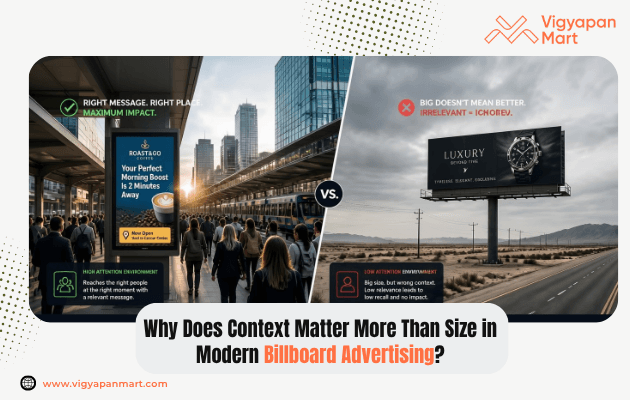
We all have seen giant billboards that naturally attract our attention. But it's 2026 and now, size and attention don't guarantee your advertising success.
Modern outdoor advertising says that where, when, and how an advertisement appears matters more than how large it is.
A Billboard that reaches the right audience can easily bring you more results the larger Billboard in the wrong location.
Sounds simple but this shift is transforming how brands plan outdoor advertising.
Outdoor advertising has grown by 13% and DOOH has grown by 18% in 2025. Now, the question is how the shift is pushing outdoor marketing and becoming a power pillar for the industry?
(EY)
Billboard Advertising
Billboard advertising uses high-visibility outdoor spaces to reach audiences at strategic locations, helping brands build awareness, recall, and local visibility.
1. The Right Location Reaches the Right Audience:
A billboard does not exist in isolation. Its surroundings influence who sees it and how they interpret it.
For example:
A large billboard on a highway may generate thousands of impressions. But if you place a billboard strategically near a premium location, it can reach your right audiences and may bring more sales.
This is the basic principle of contextual OOH advertising:
Reach the right people in the right place.
The traffic is important, but audience quality matters as well.
2. Context Makes an Advertisement More Relevant:
People see hundreds of ads every day. A billboard needs to connect with its surroundings to stand out.
For example:
- A food delivery brand can promote lunch offers near office clusters around noon.
- A travel company can promote holiday packages near an airport.
- A retail brand can advertise a store close to its outlet.
The location gives the message additional meaning.
Instead of simply saying, “Buy our product,” the advertisement becomes relevant to what the audience is doing at that moment.
That relevance can make a simple creative more memorable than an oversized but generic advertisement.
3. Digital OOH Has Made Context Even More Powerful:
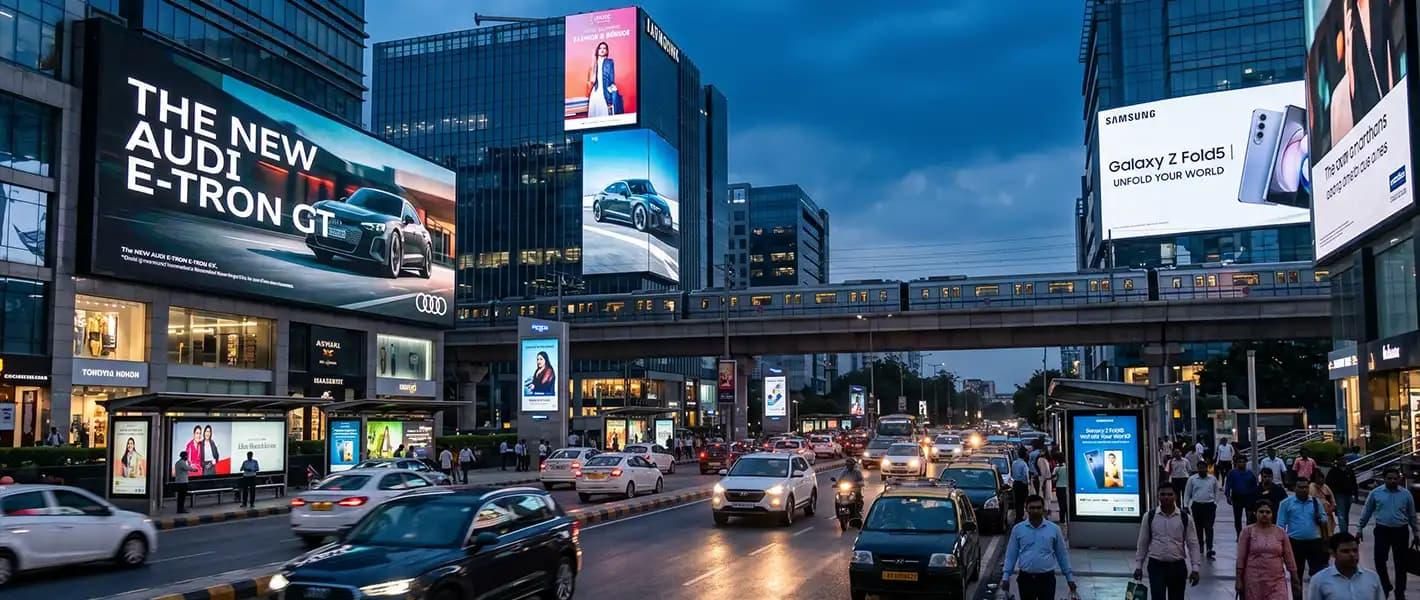
The rise of Digital Out-of-Home (DOOH) has changed billboard advertising significantly.
Digital screens allow advertisers to change messages based on time, location, audience patterns, events, and other contextual signals.
India's DOOH market generated about US$282.6 million in revenue in 2024 and is projected to reach US$630 million by 2030, representing a 13.8% CAGR from 2025 to 2030. Billboards were the largest revenue-generating format in India's DOOH market in 2024. (Grand View Research)
This means advertisers can move beyond the traditional “one billboard, one message” model.
A digital billboard can show a breakfast message in the morning, a different offer during lunch, and another creative during the evening commute.
The screen does not become bigger. The message becomes smarter.
4. Timing Can Multiply the Impact:
Context is not only about location. It's about Time too!
For example:
A coffee brand advertising at 8 AM near a busy office route. Now compare that with the same advertisement appearing late at night.
The creative, location, and audience may remain the same, but the context changes.
Modern OOH campaigns can use different creatives for different parts of the day. This makes the advertisement feel less like an interruption and more like a useful message.
Transit Advertising
Transit advertising places brand messages on buses, trains, e-rickshaws, and other moving vehicles to deliver repeated visibility across busy routes and neighbourhoods.
5. Big Does Not Always Mean Better:
Large formats still have an important role in OOH advertising. They provide strong visibility and can create brand dominance.
But size has limitations.
A huge billboard cannot compensate for:
- Poor location
- Low-quality creative
- Weak audience relevance
- Difficult readability
- Excessive messaging
- Poor visibility
- Wrong campaign timing
For example:
A small billboard at a traffic signal can give several seconds to people to read a message. On the other hand, a big billboard on the highway will get only a fraction.
Therefore, advertisers should measure more than physical dimensions such as:
- Visibility
- Dwell time
- Audience profile
- Frequency
- Context
Does a bigger billboard always mean better advertising results?
No. Size only guarantees visibility, not results. What actually drives impact is the right message reaching the right audience at the right location and time — a smaller, well-placed billboard often outperforms a giant one in the wrong context.
6. Data Is Making Context More Measurable:
The modern OOH industry is becoming increasingly data-driven.
Advertisers can now use audience data, mobility patterns, traffic information, location intelligence, and digital screen data to make better media decisions.
This shift is already visible globally.
The U.S. OOH advertising hit $9.46 billion in 2025 and is growing 3.6% year over year. The DOOH industry hit 36.3% of total OOH revenue and grew 10.5% during the year. (OAAA)
The message is clear: OOH is not simply about buying physical space anymore. It is about buying relevant moments of attention.
Metro Advertising
Metro advertising uses high-footfall stations, trains, platforms, and digital screens to help brands reach large urban audiences during their daily journeys.
7. The Future of Billboard Advertising Is Contextual:
The biggest billboards are not the best ones. Instead, look for a billboard that reaches the right audience with the right message at the right moment.
For brands, this means OOH planning should start with questions such as:
1. Who are we trying to reach?
2. Where do they travel?
3. What are they doing there?
4. When are they most receptive?
5. What message will make sense in that environment?
Once you find the answers to these questions, size becomes one part of the strategy.
How Can Vigyapan Mart Help with Contextual Billboard Advertising?
Vigyapan Mart is a 360-degree marketing and OOH advertising agency and helps brands plan smarter billboard and OOH campaigns by focusing on location, audience, visibility, context, timing, and campaign objectives.
Conclusion:
Modern OOH is not about the size. It's about relevancy. Moreover, the consumers have become smarter and buy things they like or need the most.
So, your outdoor ads should have the right location and relevancy for hitting the right audience.
In this blog, we have discussed how the right billboard today uses digital screens, location, time, relevancy, and insider jokes for better engagement and sales.
Context here is the main key. OOH advertising is becoming smarter, digital, measurable, and data-driven so before you place your ad anywhere, plan with data.
The future billboards may be of small sizes but of big stories. Want expert guidance on finding the right location for your billboard ads? Connect with Vigyapan Mart experts today.
Frequently Asked Questions
Subscribe to our newsletter
Get updates instantly! Join our community for the latest marketing insights.