
DOOH Basics: Why Digital Billboards Outperform Static in 2026?
DOOH basics explain why digital billboards outperform static OOH advertising in 2026. With real time content updates better engagement measurable ROI and sustainable benefits DOOH helps Indian brands achieve higher recall flexibility and stronger campaign performance in competitive urban markets.
Published April 9, 2026 · Updated April 13, 2026
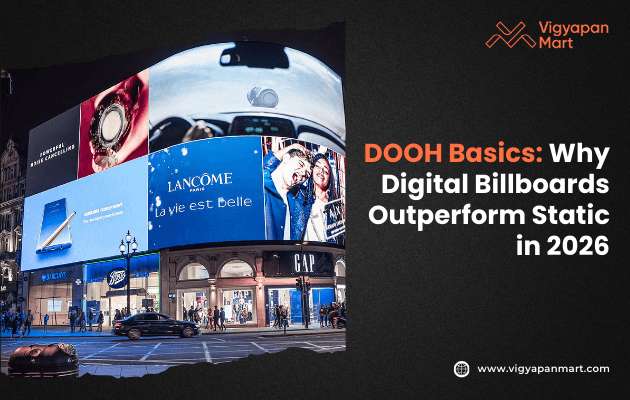
In busy Indian cities like Mumbai or Delhi, OOH advertising grabs eyes on the go. But here’s a tweak. While static billboards stay the same all the time, Digital Out-of-Home (DOOH) billboards change content in seconds. Now, the question is, why does this matter in 2026? OOH advertising is booming with smart tech like AI and 5G. Combining these with DOOH ads gives real-time ad content that matches traffic, weather, or festivals. Static OOH just sits there, with one ad format for all time, whereas DOOH changes based on the real-time data. Results? Your OOH ads become more relevant, producing more results.
In this blog, we will discuss DOOH basics and why it beats static in OOH advertising for better reach, savings, and results. Read this blog till the end, and you will find why it's good switching to DOOH for higher engagement.
The DOOH Advantage: Core Basics and Tech Edge
OOH advertising has evolved fast. Earlier, OOH ads used to be made of vinyl paper; now it’s the DOOH with bright LED screens for OOH spots like highways and malls. Brands can update their ads remotely via apps and don’t need workers to climb ladders. In 2026, DOOH screens can play 4K video and AR effects, making OOH advertising pop. On the other hand, static billboards in OOH ads use vinyl sheets that fade in rain or sun. Moreover, they don’t change. DOOH wins in this case with sensors tracking crowds or weather.
For example, during the monsoon, DOOH ads can easily switch to umbrella ads. This boosts relevancy and offers quick attention from the viewers passing by. As per reports, DOOH OOH advertising lifts brand recall by 2-5 times over static. This is clearly more beneficial for brands, looking for more awareness, market buzz, and conversions.
Reason 1: Unmatched Flexibility and Real-Time Relevance
Flexibility rules OOH advertising in 2026, and DOOH lets you do that. You can easily swap the ad messages hourly and monitor traffic. Think about a food chain that offers breakfast deals in the morning, lunch specials in the afternoon, and promotes an evening special to the evening crowd. Moreover, Programmatic OOH platforms use data to target the right people at the right time.
Static OOH billboards can't do this. Brands get stuck with one design for a month. For example, Diwali sales OOH ads can’t change to Christmas and New Year Offers. Static OOH is less interactive and boring for the young generation, while DOOH keeps OOH advertising fresh and relevant.
Reason 2: Superior Engagement and Measurable ROI
People ignore static OOH billboards after a glance. But DOOH advertising hooks the viewers with videos, animations, and QR codes. People can scan the QR codes for discounts, tap the NFC and explore more from your OOH ads.
The best part? This OOH ad format helps you track everything in OOH advertising. The camera counts views, and apps measure clicks to sales. This empowers you with data, whereas static ads often work only on guesses. In 2026, DOOH OOH tools link to Google Analytics, proving ROI. Several DOOH advertising agency have noted 30-40% higher engagement for DOOH vs static.
Reason 3: Cost-Efficiency and Sustainability Wins
Upfront costs of DOOH are surely high and often cost you 20-30% more than static OOH. But it pays back. The ROI returns the value, but that’s not all. LEDs use 70% less power than old lights, and brands can use one DOOH screen for 100 campaigns. There is no need to reprint all the time.
Static OOH means printing, transport, and disposal. This is not only costly but increases the waste contribution. In 2026, where the Government is pushing brands for sustainability, DOOH offers sustainable OOH advertising. Moreover, DOOH cuts long-term costs, and CPM also falls to ₹300-500 vs static's ₹800+. Indian cities like Bengaluru mandate eco-OOH in which DOOH ads fit perfectly.
Challenges and Future Outlook for 2026 OOH Ads
DOOH OOH advertising isn't perfect as well. There are several challenges that brands must overcome. It has a high setup cost and may irritate the audience with content overloading. Now, brands can easily fix that with AI-powered OOH ads. This can rotate the ads timely, and with the 5G tech, it boosts your OOH with live streams and social ties. Notably, India's DOOH OOH market nears ₹5,000 crore, blending transit and retail screens.
Conclusion
DOOH transforms OOH advertising in 2026 and outshines the static ads with flexibility, engagement, and smart savings. From real-time updates to proven ROI, it’s the future for Indian brands in crowded markets. Static billboards belong to the past now. It’s time to switch to DOOH for OOH advertising that drives real action. So what should brands do? Audit your OOH strategy now and test a DOOH ad campaign in your city, and watch the sales climb. Ready to give your OOH ads a digital upgrade? Connect with Vigyapan Mart OOH experts today.
Subscribe to our newsletter
Get updates instantly! Join our community for the latest marketing insights.