
Why Are Shorter, Simpler Billboard Messages Winning in India's Busy Urban Corridors?
In this blog, see why brands are choosing shorter billboard copy in urban India, and how the 3-second test and 5 simple questions can help you design a more effective OOH creative.
A billboard has only a few seconds to make an impression. A commuter may see it while driving through a junction. A passenger may notice it from a moving bus. Someone at the traffic signal may see it for only a second. This makes one thing clear. A billboard has approximately no time to communicate. It can’t work as a newspaper ad, website or social media post.
This matters in today’s Urban India because people are constantly on the move. They have less time than ever, and your OOH ads must compete for their attention.
Note:
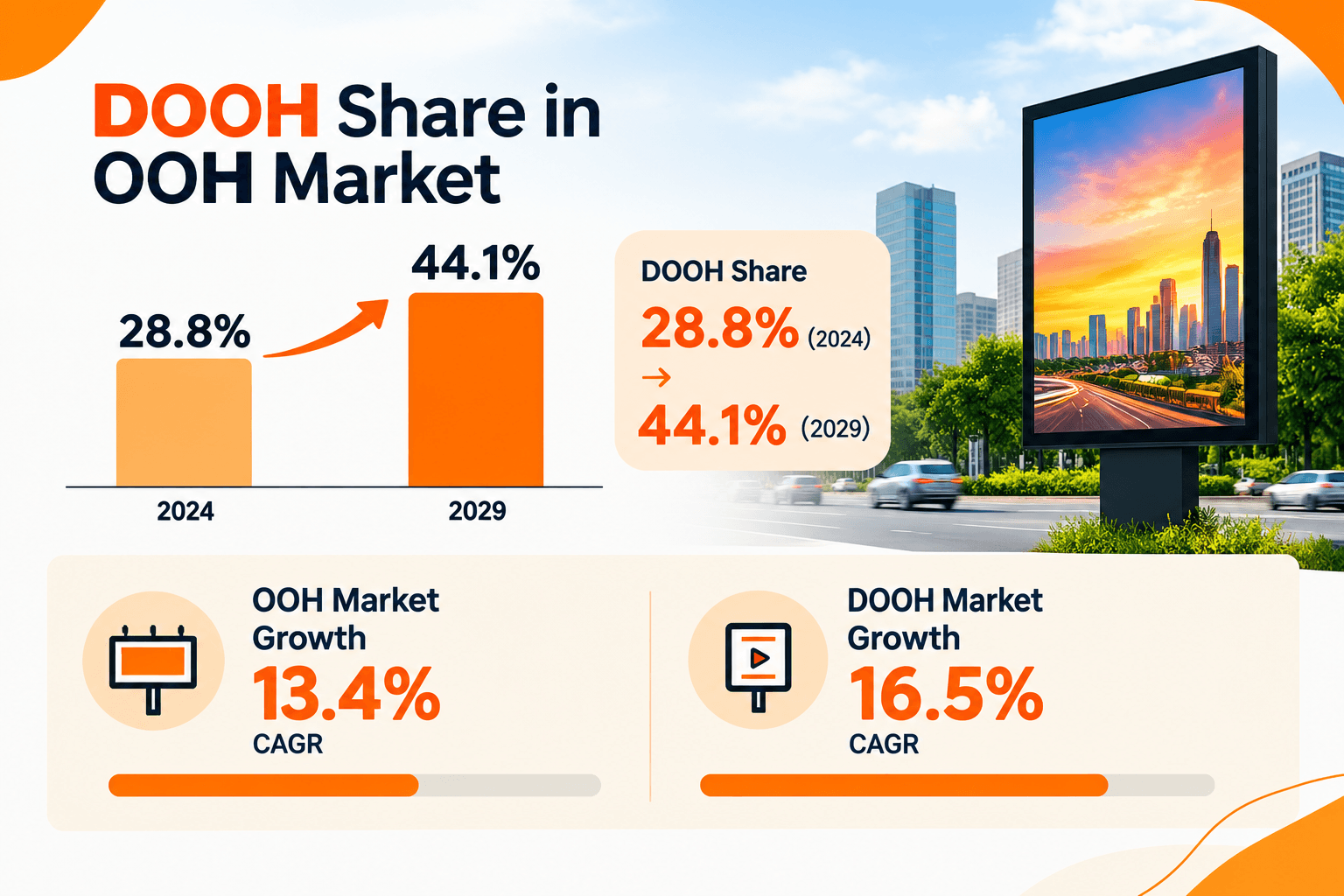
India’s OOH advertisement market is growing at a 13.4% Year-on-Year whereas Digital OOH ads may grow at a 16.5% CAGR.
The Digital OOH ads may hold 44% for the total OOH ad industry by 2029.
Source: (PwC expects)
These numbers show that more brands are entering these spaces, and the question is no longer this:
“Can people see the billboard?”
It is:
“Can They Understand Your Ad Message?”
Billboard Advertising
Billboard advertising is an outdoor advertising format that displays brand messages, product information, offers or campaigns on large advertising structures placed in high-visibility public locations such as roads, highways, junctions and commercial corridors.
Urban Audiences Don’t Have Time to Read the Billboards:
People often don't get the time to read billboards. They see it while they travel, walk, or move in a cab. Their attention is divided between conversations, phones, road signs, traffic, and hundreds of visual elements.
This changes how brands should approach billboard copy.
A long headline may look impressive during the design stage but become difficult to process on the road.
Compare these two approaches:
Long:
“Discover a premium residential lifestyle designed for modern families with spacious homes and world-class amenities.”
Short:
“Your Space. Your Life.”
The second message does not explain everything. But it creates curiosity.
The Three-Second Test Matters:
A useful way to evaluate billboard creative is to ask:
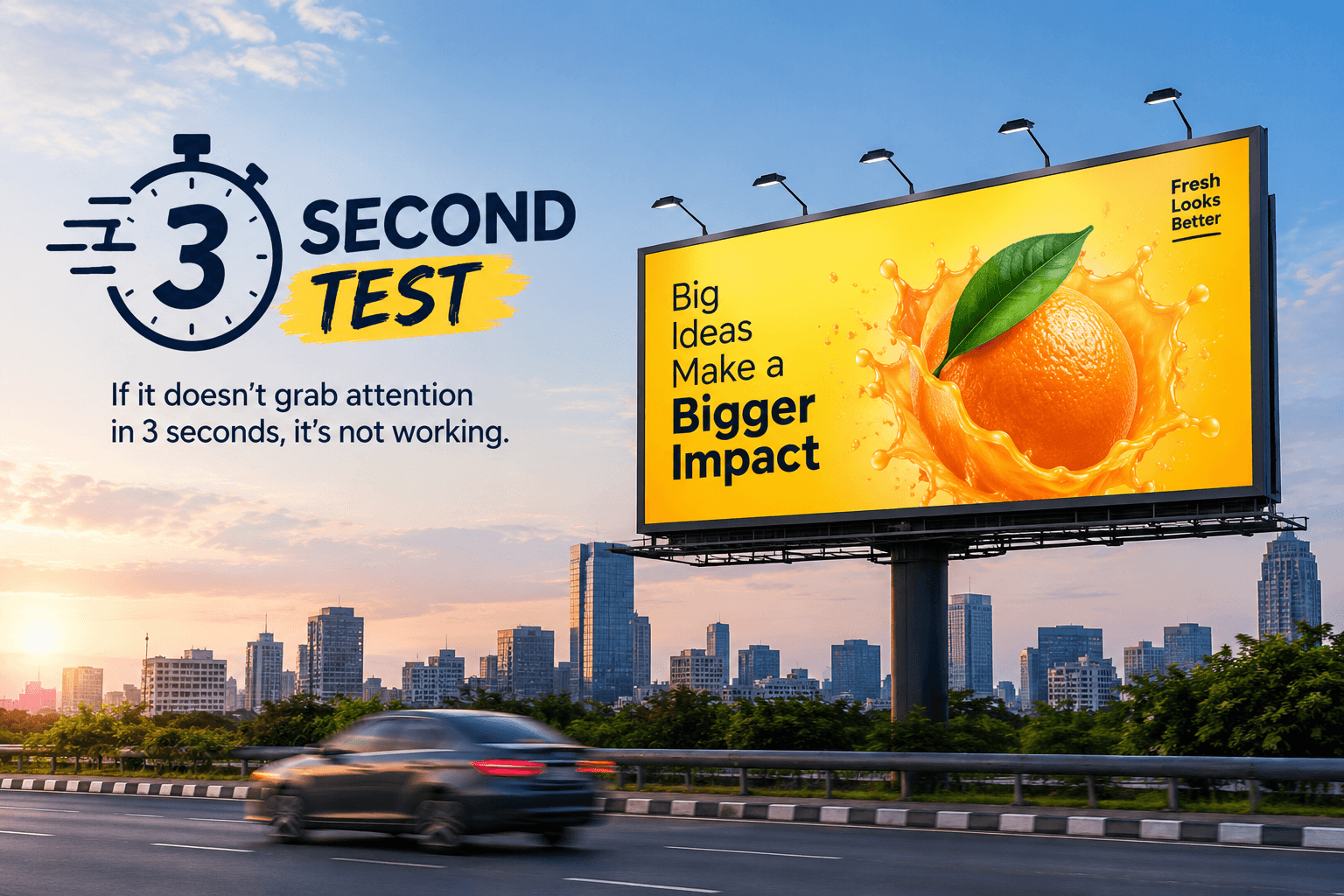
Can someone understand your main ad message in 3 seconds?
If the answer is no, you must simplify the billboard creative.
This doesn't mean that you must complete every billboard ad message in 3 words. The ideal length heavily depends on:
- Location
- Traffic
- Speed
- Viewing Distance
- Format
- Campaign Objectives.
But the basic formula is the same for all.
The faster the audience moves, the faster your message must work.
This formula becomes extremely valuable when you look at the OOH advertising data in India. In 2025, billboards accounted for 44.2% of India’s OOH revenue and transit media is expected to grow at an 8.05% CAGR through 2031.
Urban Billboards Are Fighting for Attention:
The modern city is visually crowded.
There are billboards, shop signs, digital screens, traffic signals, vehicle branding, metro advertisements, LED displays and mobile screens everywhere.
Digital OOH advertisements are a new layer to this ecosystem. Digital screens create more opportunities for brands. But they also create more competition for attention.
This is why creative simplicity becomes a strategic advantage.
OOH Advertising
OOH advertising, or Out-of-Home advertising, refers to advertising that reaches people while they are outside their homes. It includes billboards, transit advertising, metro advertising, airport advertising, street furniture, digital screens and other public-space media formats.
Short Copy Creates Faster Brand Recognition:
A strong billboard usually has one core job: raising awareness. We as marketers can divide it into multiple tasks such as:
- Engage with the audience.
- Introduce a brand
- Promote a product
- Announce a launch
- Communicate an offer or build recall.
But don't try to do all these things at once. It makes the creative process difficult and complicates the advertising process.
For example:
A travel brand could simply say:
“Your Holiday Starts Here.”
Moreover, you can add multiple supporting elements too:
- Destination visuals
- Brand logo
- QR Code
- Quick CTA
This creates a hierarchy:
Headline → Visual → Brand → Action
The audience does not need to read everything to understand the communication.
Simple Does Not Mean Boring:
There is an important difference between simple and generic.
“Buy Now” is short, but it does not necessarily create interest.
“Made for Monday” is also short, but it can create curiosity when paired with the right product and visuals.
A good OOH copy uses fewer words without losing an
idea.
Brands can achieve this through:
- Strong verbs
- Short phrases
- Familiar language
- Large typography
- One clear visual
- Strong brand placement
- Minimal supporting information
The objective is not to remove creativity.
It is to concentrate creativity.
DOOH Makes Simplicity Even More Powerful:
Digital billboard cost in india bring another advantage: brands can change messages based on time, location, audience context or campaign requirements.
India’s digital OOH market is expanding rapidly. And with dynamic screens, brands do not necessarily need one billboard to communicate everything.
They can use multiple short messages.
For example:
Morning:
“Running Late? We Get It.”
Afternoon:
“Lunch Plans?”
Evening:
“Take The Long Way Home.”
The creative becomes more contextual without becoming more complicated.
What Should Brands Ask Before Designing a Billboard?
Before approving a billboard, marketers can ask five simple questions:
1. Can the main message be understood quickly?
If the viewer needs to read the entire billboard, simplify it.
2. Is there only one primary idea?
If the billboard is promoting five things, decide which one matters most.
3. Can the brand be recognised immediately?
A memorable message is less useful if people do not remember who said it.
4. Does the visual support the headline?
The image and copy should work together instead of competing for attention.
5. Does it work from a distance?
Always view the creative at its actual billboard size and consider the distance and speed at which people will see it.
Metro Advertising
Metro advertising uses metro trains, stations and commuter areas to display brand messages. Common formats include train branding, platform panels, station takeovers, digital screens, pillars, escalators and other metro media spaces.
How Can Vigyapan Mart Help With Billboard Advertising?
Vigyapan Mart helps brands plan and execute billboard and OOH advertising campaigns based on their target audience, locations, campaign objectives and budget. From site selection and media planning to creative execution and campaign management, Vigyapan Mart provides end-to-end OOH advertising solutions.
Conclusion:
India’s OOH industry is becoming larger, more digital and more measurable. PwC expects DOOH to account for 44.1% of India’s OOH revenue by 2029, compared with 28.8% in 2024.
Source: (PwC expects)
But technology does not change one basic reality:
People still have limited attention. A billboard may be huge but has very little time to convey its messages. More importantly, it needs to compete with everything around it.
Therefore, a shorter ad copy is not just a trend. It’s about quick experiences.
The strongest billboards may not be the largest, most visible, or most filled. It is the one that shares the idea in seconds. Searching for reliable billboard advertising services in Delhi? Connect with Vigyapan Mart OOH experts today.
Frequently Asked Questions
Subscribe to our newsletter
Get updates instantly! Join our community for the latest marketing insights.