
Giant Hoardings vs. Clusters: Scale Strategies for Maximum Brand Recall
Giant hoardings and cluster OOH advertising are powerful scale strategies for maximum brand recall. While large hoardings deliver strong visual impact and authority, cluster placements build repetition and local presence across Delhi NCR to improve awareness and campaign performance.
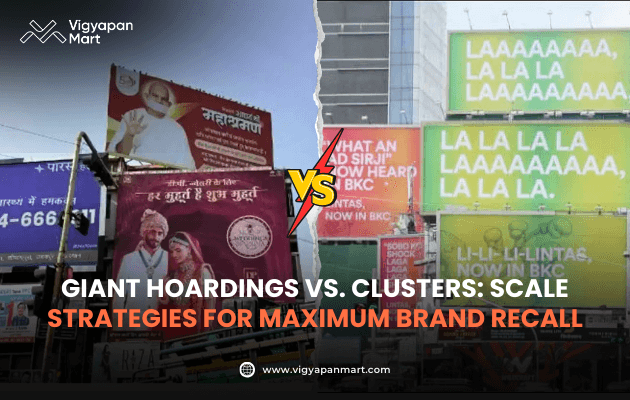
In today’s competitive market, brands are fighting hard for attention. It's true that Digital ads are everywhere, but OOH (Out-of-Home advertising) still remains a powerful advertising method in big cities like Delhi, Gurgaon, and Noida. WHY? When people travel daily on highways, metro routes, and busy roads, they see OOH ads. These OOH ads create a strong visual impact. But one important question is still here. Should a brand go for one giant hoarding or multiple hoardings in clusters? Both are strong OOH strategies, but they work differently. The point is that brands often lose their opportunities because of misunderstanding both OOH advertising and how to utilise them for the best results. In this blog, we will clearly understand which scale strategy creates maximum brand recall and when to use each one.
Understanding Giant OOH Hoardings
Giant OOH hoardings are large-size billboards that are placed at premium, high-traffic locations. In cities like Delhi and Gurgaon, you will see them near expressways, flyovers, and commercial hubs. These hoardings are the kings of the skyline and immediately grab attention. In OOH advertising, a giant hoarding works like a bold statement. It gives instant visibility and makes the brand look powerful and premium. When someone sees a huge creative display across a major road, it creates a strong visual memory. This type of OOH is impact-driven. Even if a person sees it once, the size itself makes the brand hard to ignore.
Giant hoardings are suitable for:
- New product launches
- Big brand announcements
- Automobile campaigns
- Real estate mega projects
However, they usually require higher investment because prime locations in Delhi NCR are expensive. But when the objective is strong brand positioning, giant OOH formats deliver strong impact.
Understanding Cluster Strategy of OOH Advertising
Cluster strategy means placing multiple medium or small hoardings in one particular area. Instead of one large OOH site, the brand uses several placements across a locality. For example, in Noida or South Delhi markets, you might see the same brand message repeated on multiple boards within 2-3 kilometers. This repetition increases frequency. When people pass through the same route daily, they see the brand again and again. This builds strong recall through repetition. Cluster OOH strategy works well for:
- Retail brands
- Educational institutes
- Local real estate projects
- Hospitals and clinics
This approach is frequency-driven. Instead of one big impression, it creates multiple reminders. It also gives the feeling that the brand is everywhere in that area. For businesses targeting a specific zone in Delhi or Gurgaon, clusters can be very effective.
Giant OOH Hoardings vs. Clusters OOH Advertising: Key Differences
Here are some key features of giant OOH hoardings and cluster OOH advertising:
Giant Hoardings
- Large size
- Premium positioning
- Strong first impression
- Wide audience coverage
Cluster Strategy
- Multiple smaller sites
- Area-focused targeting
- High frequency visibility
- Strong local presence
If your brand wants city-wide visibility in Delhi, a giant hoarding near a major highway can create strong awareness. But if your brand is opening a store in a specific part of Gurgaon, clusters around that area may bring better results. In OOH, both strategies aim for recall, but the method is different. One works through scale, the other through repetition.
The Psychology Behind Brand Recall
Human memory works in two strong ways: The first is impact and the second one is repetition. Notably, OOH ads as a visual work of art uses both. A giant hoarding creates shock value. Its size and design leave a bold impression. Even if someone passes by quickly, the visual scale hits their attention and stays in their mind. On the other hand, clusters use the power of frequency. When people repeatedly see the same brand message during their daily commute in Delhi NCR, it becomes familiar. Familiarity builds trust, and trust builds recall.
So, in OOH advertising, understanding audience movement patterns is very important. In cities like Delhi, where traffic movement is heavy and daily routes are common, both strategies can work well depending on planning.
Budget and ROI Perspective of Hoardings and Cluster OOH Ads
Budget plays a major role in choosing the right OOH scale strategy. Giant hoardings in prime Delhi locations can be expensive. But they provide strong visibility in one go. Clusters distribute the budget across multiple sites. While individual sites may cost less than a giant hoarding, the total cost depends on how many boards are used. ROI depends on campaign objective:
- For strong brand image and authority, giant OOH formats may deliver better value.
- For local store visits and regional focus, cluster OOH strategy may generate stronger recall.
There is no fixed formula. The right choice depends on brand goal, target audience, and area focus.
Can Brands Combine Both OOH Advertising?
In big markets like Delhi NCR, many brands combine both strategies. For example, a brand may launch with a giant hoarding near a major expressway and support it with cluster OOH placements in nearby markets. This layered approach increases both impact and repetition. First, people notice the brand because of the large hoarding. Then they keep seeing it through cluster placements. This improves overall recall. Smart OOH planning often uses a mix of scale and frequency for better results.
Conclusion
Giant hoardings and cluster strategies are both powerful tools in OOH advertising. The difference is not about which one is better, but which one suits your goal. In big cities like Delhi, Gurgaon, and Noida, audience movement, traffic flow, and location selection matter a lot. A giant hoarding creates bold impact and strong brand authority. Cluster OOH builds repetition and local dominance. When planned properly, OOH works like a moving gallery, a true work of art that speaks to thousands daily. So what to do now? Understand your requirements and partner with an OOH advertising agency, and scale your business accordingly. Looking for a reliable OOH ad partner? Connect with Vigyapan Mart OOH experts today.
Subscribe to our newsletter
Get updates instantly! Join our community for the latest marketing insights.