
What Is Metro Station Co-Branding and Why Are Brands Investing in It?
In this blog, we explain what metro station co-branding is and why more brands are investing in it. It is an OOH strategy where a brand adds its name alongside a metro station's name, with branding across entry points, concourses, and platforms. Lakhs of commuters pass through daily, giving brands repeated, high-recall visibility. We also cover the key benefits and how to plan a campaign that delivers measurable results.
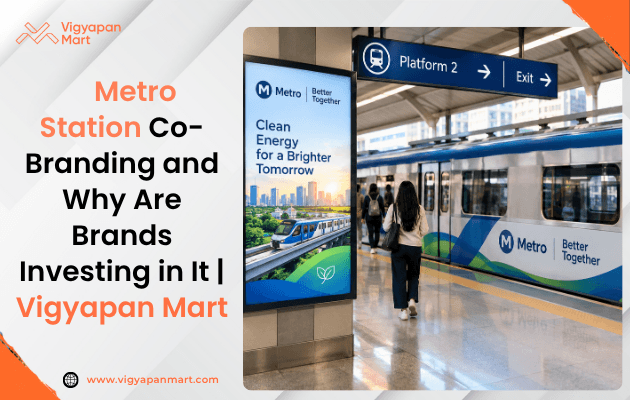
A metro station is no longer just a place where people board and leave trains. It is becoming a high-value media space for brands.
But there is one rising trend almost all big brands are looking for now. It’s ‘Metro Station Branding.
Metro Station Co-Branding is different from a billboard or digital screen inside a station. It doesn’t wrap the metro trains as well. Instead, it associates its name with the station itself.
The result is a longer and more integrated brand presence across the commuter journey.
India's growing metro network is creating more opportunities for this ad format. In 2014, the total metro network in India was around 250 km where by 2025, it crossed 1000 km across 23 cities. Also, the daily ridership reached a record high at 1.12 crore passengers in 2024-25
So, what exactly is metro station co-branding, and why are brands investing in it?
Metro Train Advertising
Metro train advertising is a form of transit and outdoor advertising that displays brand messages across metro trains, stations, platforms, digital screens and other approved metro media spaces.
What Is Metro Station Co-Branding?
Metro station co-branding is a form of transit OOH advertisement in which a brand gets the right to associate its name with a metro station.
The brand name can appear as a prefix or suffix to the existing station name. Depending on the agreement, the package can also include advertising rights across the station.
For example, a station can carry a format such as:
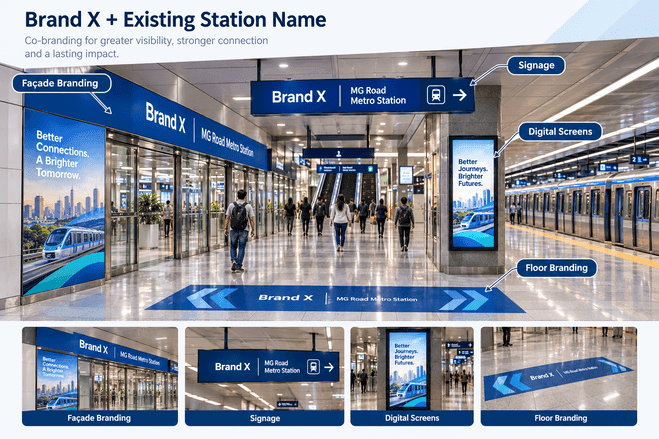
Brand X + Existing Station Name
The branding can then extend to station signage, façades, indoor displays, floor branding, digital screens and other approved ad formats.
DMRC runs a co-branding framework that allows brands to add their names to selected station names. Its earlier RFP also included outdoor and indoor ad inventory, digital ad displays, floor and roof branding, and even announcements inside trains.
This makes co-branding different from a standard ad billboard campaign. The brand becomes part of the physical identity of the location.
Why Is Metro Station Co-Branding Growing?
The first reason is simple: metro audiences are large and repetitive.
In fact, the Delhi Metro alone recorded 235.8 crore passengers, with an average of around 64.6 lakh journeys per day.
Repetition is a core fundamental rule for marketing, and metro co-branding offers you that. A commuter may pass through the same station five or six days a week, checking your name multiple times a day.
Over time, the station name itself can reinforce brand recall.
This gives co-branding an advantage over a short-duration advertisement that a commuter may see only once.
Transit Advertising
Transit advertising is a form of outdoor advertising that communicates brand messages through advertising media associated with public transportation systems, including buses, metros, and trains. Among these formats, best bus advertising is the most effective choice for brands that want city-wide reach and high-frequency visibility, since buses cover multiple routes and localities every day.
From Advertising Space to Brand Ownership:
Traditional OOH advertising usually gives a brand a specific advertising surface.
Co-branding goes one step further.
A brand can become associated with the location itself.
For example:
1. In June 2026, Phoenix Marketcity was associated with Mumbai’s Jagruti Nagar Metro Station.
2. In March 2025, Pidilite partnered with Mumbai’s Marol Naka Metro Station and renamed it Fevicol Marol Naka.
3. In April 2026, Ixigo created “Ixigo New Delhi Metro Station” and also launched the branding in-train announcements.
For brands that have a nearby store or office, metro co-branding becomes their real-world destination itself.
It Offers Multiple Touchpoints:
Another reason brands are investing in co-branding is the number of touchpoints available within one property.
A co-branding package can potentially combine:
- Station-name branding
- Entrance and façade branding
- Platform and concourse displays
- Digital screens
- Floor and pillar branding
- Directional signage
- Promotional installations
- In-train announcements
- Experiential activities
This creates a connected campaign rather than a collection of unrelated advertisements.
The commuter can encounter the same brand while entering the station, walking through the concourse, waiting for a train and hearing the station announcement.
That repetition can make the ad campaign more memorable.
Metro Is Becoming a Bigger Part of Transit OOH:
The wider ooh advertisement market is also moving towards transit environments.
According to research, in 2025, India’s OOH ad market was around 30% of the total OOH ad industry in India, and it would rise to 33% in 2028.
This research also shows how the rise of metro and rail expansion is contributing to the growth of ridership, high-traffic location, and ROI.
This matters because brands are increasingly looking for environments where audiences are both large and highly repetitive.
Metro stations provide both.
Metro Operators Also Benefit from Metro Advertising:
Co-branding is not only attractive to advertisers. It also creates a non-fare revenue opportunity for metro operators.
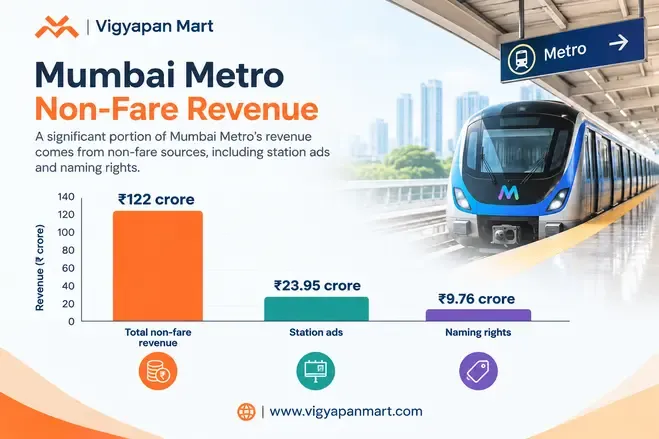
For example, Mumbai Metro's non-fare revenue increased sharply during 2024-25. Its reported ₹122 crore in non-fare revenue included ₹23.95 crore from station advertising and ₹9.76 crore from station naming rights and branding.
The model is also expanding to newer networks. In 2026, NCRTC awarded exclusive semi-naming/co-branding rights covering 21 stations on the Delhi-Meerut Namo Bharat Corridor. The first-year licence fee for Ghaziabad (Elevated) station was ₹1.08 crore.
Metro Station Advertising
Metro station advertising is a form of outdoor advertising that uses media spaces within and around metro stations, including platforms, entrances, pillars, digital screens, concourses and other station areas.
What Makes It Valuable for Brands?
Metro Station co-branding is a young OOH ad format where the brand partners with the station itself. That’s not a mere billboard or announcement.
The advertising becomes a part of the location itself. This provides three big winning advantages for OOH advertisers and brands.
- Scale
- Repetition
- Context
A conventional advertisement asks commuters to notice a brand.
Co-branding can make commuters repeatedly say, hear, read and associate the brand with a physical location.
That can be particularly useful for several industries such as:
- Retail
- real estate
- financial services
- education
- healthcare
- travel
- technology
- entertainment and
- consumer brands
These industries often look for building strong urban visibility and brand recall.
How Can Vigyapan Mart Help With Metro Advertising?
Vigyapan Mart offers end-to-end metro advertising solutions to help brands reach commuters across high-footfall metro stations and transit spaces. From media planning and station selection to station branding, digital displays and campaign execution, our team helps businesses build campaigns aligned with their target audience, budget and marketing objectives.
Lakhs of commuters use metro networks every day, making them one of the most reliable ways to reach working professionals, students and daily travellers at scale. Here's what we cover:
- Formats: Station branding, train wraps, digital screens, platform and pillar branding, concourse displays and entry/exit gate branding.
- Cities: Delhi Metro, Mumbai Metro, Bengaluru (Namma Metro), Hyderabad, Kolkata and other networks across India.
- Execution: Permissions, creative adaptation, printing, installation and post-campaign reporting.
Whether you're a startup launching in one city or a national brand planning a multi-city rollout, we build campaigns that match your goals. Not sure where to start? Read our metro advertising cost guide or explore our metro advertising case studies.
Conclusion:
As India's metro network continues to expand, station co-branding is likely to become a larger part of transit OOH planning.
The opportunity is no longer limited to putting a logo on a wall. Brands can use the station environment to build a complete experience around a location.
For metro operators, it creates an additional revenue stream. For advertisers, it provides repeated exposure in high-footfall environments. And for commuters, it creates a more branded and experiential transit environment.
The key shift is clear: metro stations are moving from being advertising locations to becoming branded media properties.
Searching for reliable experts for your first Metro Advertising campaigns? Connect with Vigyapan Mart today.
Frequently Asked Questions
Subscribe to our newsletter
Get updates instantly! Join our community for the latest marketing insights.